
Pictured: Sonic Youth
← Today’s issueThe daily of where sound came fromp. 34
Born 1987 · The American college-radio wave before Nevermind
Alternative rock
Not a sound so much as a decades-long argument about what counted as an alternative to the mainstream — American college-radio bands who wanted nothing to do with arena rock, then, after Nirvana's Nevermind made "alternative" a chart category, a marketing label stretched over almost anything guitar-based that wasn't classic rock or metal. There is no single alt-rock sound; that absence is the actual story.
See it on the map →How it started


The term predates Nirvana by years — American college radio in the mid-to-late 1980s built an entire circuit (R.E.M., Hüsker Dü, The Replacements, Sonic Youth, the Pixies, Dinosaur Jr.) out of bands the major labels and commercial rock radio had no use for, unified by where they got played and how they toured rather than by a shared riff or tempo. That circuit is "alternative" in the term's original, literal sense: an alternative to the mainstream, not yet a genre of its own.
We were very energized by it... the Minutemen always represented something a little bit closer to my heart.
Nirvana's Nevermind (1991) collapsed the distinction almost overnight — a record built out of the same underground's vocabulary (the Pixies' loud-quiet-loud dynamics chief among its acknowledged influences) sold itself straight into the mainstream it had defined itself against, and "alternative" became a radio format and a record-store bin as much as a description of anything specific. Everything that followed — a wave of 90s bands signed in Nevermind's wake, Britpop's own UK answer to the same moment, and a 2000s-onward revival that kept reaching for the label — inherited the name without inheriting a single sound to go with it.
Essential records
Start here
Nevermind
 Nirvana1991
Nevermind takes the quiet-loud dynamics Kurt Cobain openly borrowed from the Pixies and tightens them into some of the most immediate songwriting of the decade. "Smells Like Teen Spirit" rides a four-chord riff into a chorus that turns adolescent apathy into a genuine anthem, Dave Grohl's drumming giving the track a physical force no amount of radio play has worn down. The rest of the album balances that same tension between melody and noise, never settling for one at the expense of the other. Its reach far outran anyone's expectations, but the record's underground bones — hardcore's speed, noise rock's dissonance — are still audible underneath the polish.
No. 2
Daydream Nation
 Sonic Youth1988
Thurston Moore and Lee Ranaldo's guitars operate as a single extended system rather than rhythm/lead — two instruments creating interlocking drone and harmonic fields that the rhythm section navigates through rather than anchors — and the double album's seventy-plus minutes give that system room to develop in real time. 'Teen Age Riot' opens as the most fully formed example, a slow-building eight-minute piece with a guitar coda that sounds like two different songs playing simultaneously; Ranaldo's 'Eric's Trip' is the album's most purely emotional moment. It legitimized noise rock as high art in the eyes of the critical establishment — giving Sonic Youth a reputation that their major-label work both expanded and slightly complicated.
No. 3
Doolittle
 Pixies1989
The compromise between Steve Albini's raw approach on Surfer Rosa and Gil Norton's more polished production gave Doolittle the band's most commercially accessible sound without sacrificing the extremity that made Surfer Rosa essential. Black Francis's compositional approach — verses at a whisper, choruses at a scream, structures that expand and contract without warning — is most explicitly showcased on 'Here Comes Your Man' and 'Gouge Away.' Kurt Cobain cited the record directly when explaining Nirvana's quiet-loud dynamic.
No. 4
Murmur
 R.E.M.1983
Produced by Mitch Easter and Don Dixon at a studio in Winston-Salem, Murmur established R.E.M.'s sonic identity with unusual completeness for a debut — Michael Stipe's deliberately obscured vocals over Peter Buck's chiming Rickenbacker guitar created a texture that sounded like no other American band then operating. 'Radio Free Europe' is the definitive statement; 'Talk About the Passion' and 'Perfect Circle' demonstrate the band's range between urgency and atmosphere. Murmur served as the bridge between punk energy and pop songcraft that American independent rock needed, with a precision that seemed effortless.
No. 5
OK Computer
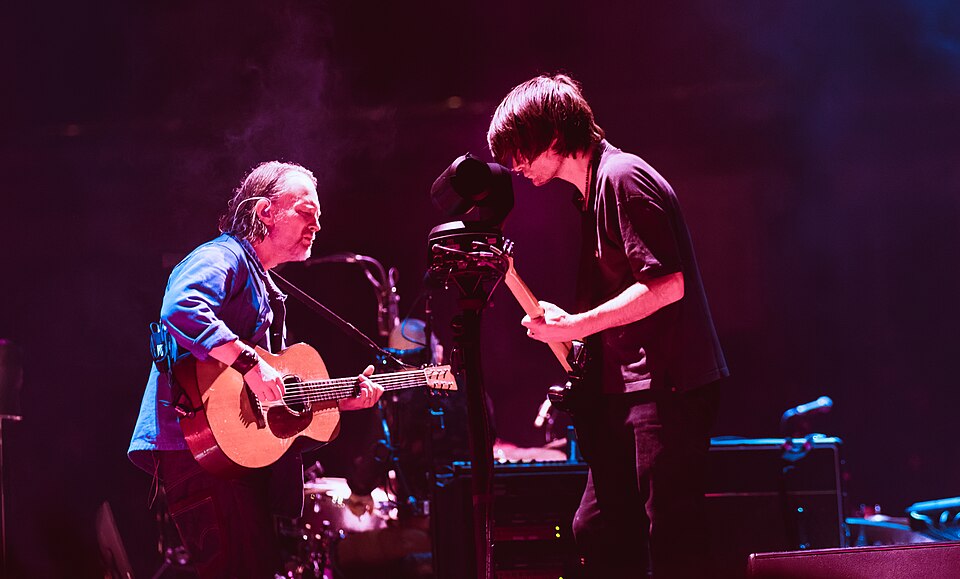 Radiohead1997
Jonny Greenwood's arrangements — orchestral strings, ondes Martenot, and studio manipulation deployed as readily as guitar — transformed Thom Yorke's anxieties about technological dystopia into one of the most sonically overwhelming albums in mainstream rock's history. 'Paranoid Android' alone justifies the album's canonical status: a six-minute suite moving through three distinct movements without ever feeling assembled rather than composed. The record reset the parameters of what a mainstream guitar album could aspire to.
No. 6
Tim
 The Replacements1985
The Replacements' most polished record was also their most fully realized — Tommy Stinson's bass locked in tighter than on any previous release, Paul Westerberg's songwriting reaching a clarity of emotional expression that the band's characteristic sloppiness had previously obscured. 'Bastards of Young' is the manifesto, a mid-tempo anthem about generational disappointment that became the unofficial anthem of disaffected mid-80s American youth; 'Left of the Dial' is the tender pole, a tribute to college radio delivered with a directness Westerberg rarely allowed himself. It remains the entry point through which most listeners discover the band.
No. 7
Zen Arcade
 Hüsker Dü1984
Hüsker Dü's double album came from a continuous recording session, largely improvised and self-produced, which gives it an urgency no major-label production could have achieved — the songs feel captured rather than constructed. Bob Mould and Grant Hart are equal songwriting forces across 23 tracks, Mould pushing toward melody and Hart toward emotional directness, including Hart's 'Pink Turns to Blue,' a devastating account of a friend's overdose. It effectively ended hardcore as the dominant mode of American underground music by demonstrating that its energy could accommodate complexity.
No. 8
You're Living All Over Me
 Dinosaur Jr.1987
Dinosaur Jr. made the record that established J Mascis's guitar sound as a singular force in American rock — massive, distorted, melodically articulate even at full volume, owing equal debts to Neil Young and to heavy metal while belonging entirely to neither. 'Little Fury Things' is a compact hook-driven piece demonstrating Mascis's ability to write a pop song inside a noise framework; 'The Lung' is a sprawling showcase where the lead line is simultaneously a riff, a solo, and a melody. The record invented the template for 1990s lo-fi indie guitar rock, a lineage running through Pavement, Sebadoh, and Guided by Voices.
No. 9
The Lonesome Crowded West
 Modest Mouse1997
Isaac Brock's jittery, philosophical yelp and the band's start-stop dynamics found their widest, sprawling canvas on this double album about the emptied-out spaces of the American West — trailer parks, highways, small towns hollowed out by sprawl. 'Cowboy Dan' builds from a hushed verse into one of the era's most unhinged vocal performances, Brock howling about a man who wants to shoot God. The band's mix of noise-rock abrasion and genuine tenderness never sat closer together than it does here. It remains the most beloved record in a catalog that would later go more polished and more popular.
No. 10
Keep It Like a Secret
 Built to Spill1999
Doug Martsch pulled back from the sprawling song lengths of Perfect from Now On without losing any of its layered, interlocking guitar lines, landing on the tightest and most immediate record of his career. 'Carry the Zero' rides a descending guitar figure through verses of quiet dread into a chorus that opens up like a widescreen shot. The interplay between Martsch's multiple overdubbed leads gives even the simplest chord changes a sense of scale. It remains the commercial and critical high point of a catalog built almost entirely on guitar tone and patience.
Who plays it
The college-radio wave, 1983–1991
The actual originators of "alternative" as a description — bands who built a self-sufficient touring and radio circuit specifically because commercial rock radio and MTV had no use for them.

The 1990s alternative explosion
Nevermind's crossover pulled a whole underground into the mainstream at once — some of it (Nirvana itself, Beck) genuinely mainstream-scale, some of it (Bikini Kill, Pavement) still resolutely independent despite carrying the same new label.


Alt-rock as marketing category, 1997–2010s
Once "alternative" had become a radio format rather than a real description, it stretched to cover almost anything guitar-based and not-quite-mainstream — a 2000s rock revival, Radiohead's studio ambition, and a decade-plus of bands that inherited the shelf label without inheriting a sound.


The 21st-century wing
A newer, mostly British generation — plus Washington DC's Mary Timony, a 90s veteran carrying the tag into her later solo work — kept reaching for the same loose umbrella decades after it stopped describing anything specific.


Where it came from, where it went
- Garage rock1963
- Proto-punk1967
- Punk1976
- Post-punk1978
- No wave1978
- Noise rock1981
- Alternative rock1987
- Where it went