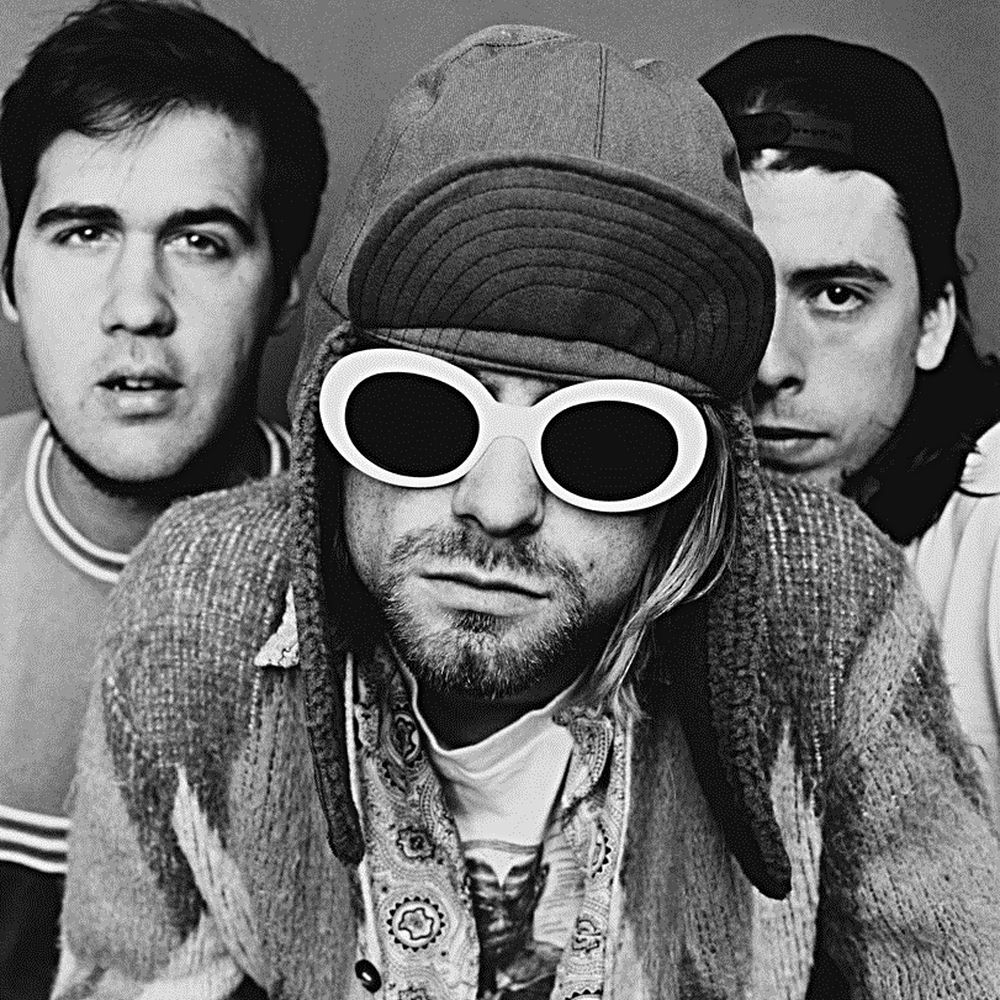
Pictured: Nirvana
← Today’s issueThe daily of where sound came fromp. 38
Born 1989 · Sub Pop; Nirvana's Bleach
Grunge
Seattle's fusion of punk's speed, metal's weight, and classic-rock melody, incubated on Sub Pop's shoestring budget before breaking worldwide almost by accident. This map covers grunge's more underground, independent half — its arena-rock wing sits outside its current scope.
See it on the map →How it started


Sub Pop built the sound's early identity as much through marketing as through any one record — the label's grimy Pacific Northwest branding gave a loose cluster of Seattle bands a shared identity before they had much else in common. Mudhoney's Superfuzz Bigmuff EP (1988) is the clearest early document of the actual sound: fuzz-pedal distortion, a slow, sludgy tempo, and a scuzzy production aesthetic that became the label's signature.
I was heavily into pop, I really liked R.E.M., and I was into all kinds of old '60s stuff.
Nirvana's Bleach, also on Sub Pop, arrived in 1989 still working inside that same underground, DIY register; Nevermind (1991), on a major label two years later, is the record that took the sound global and effectively ended grunge's run as an underground genre. The wing that followed on its commercial success — Pearl Jam, Soundgarden, Alice in Chains — turned grunge into an arena-scale radio format; all three are real, major grunge acts that sit outside this map's current roster, which tracks Nirvana's earlier Sub Pop years and Mudhoney's continued run instead.
Essential records
Start here
Nevermind
 Nirvana1991
Nevermind takes the quiet-loud dynamics Kurt Cobain openly borrowed from the Pixies and tightens them into some of the most immediate songwriting of the decade. "Smells Like Teen Spirit" rides a four-chord riff into a chorus that turns adolescent apathy into a genuine anthem, Dave Grohl's drumming giving the track a physical force no amount of radio play has worn down. The rest of the album balances that same tension between melody and noise, never settling for one at the expense of the other. Its reach far outran anyone's expectations, but the record's underground bones — hardcore's speed, noise rock's dissonance — are still audible underneath the polish.
No. 2
Superfuzz Bigmuff
 Mudhoney1988
Superfuzz Bigmuff crams a handful of blown-out, feedback-soaked garage-punk songs into a short, exhilarating EP that helped define Sub Pop's earliest sound. It arrived the same year as the standalone single "Touch Me I'm Sick," whose fuzzed-out riff and gleefully sick lyrics became the song most identified with the band's early run even though it never appeared on the EP itself. Together they capture Mudhoney at its rawest, treating volume and distortion as ends in themselves rather than obstacles to a hook. Taken as a pair, the two releases remain the clearest document of grunge's underground, pre-fame moment.
Who plays it
The underground half
Nirvana's Sub Pop years and Mudhoney's continued fuzzed-out run represent grunge's independent, DIY half — its bigger, arena-scale wing (Pearl Jam, Soundgarden, Alice in Chains) isn't yet part of this map.
Where it came from, where it went
Nothing on the map has grown out of it yet.