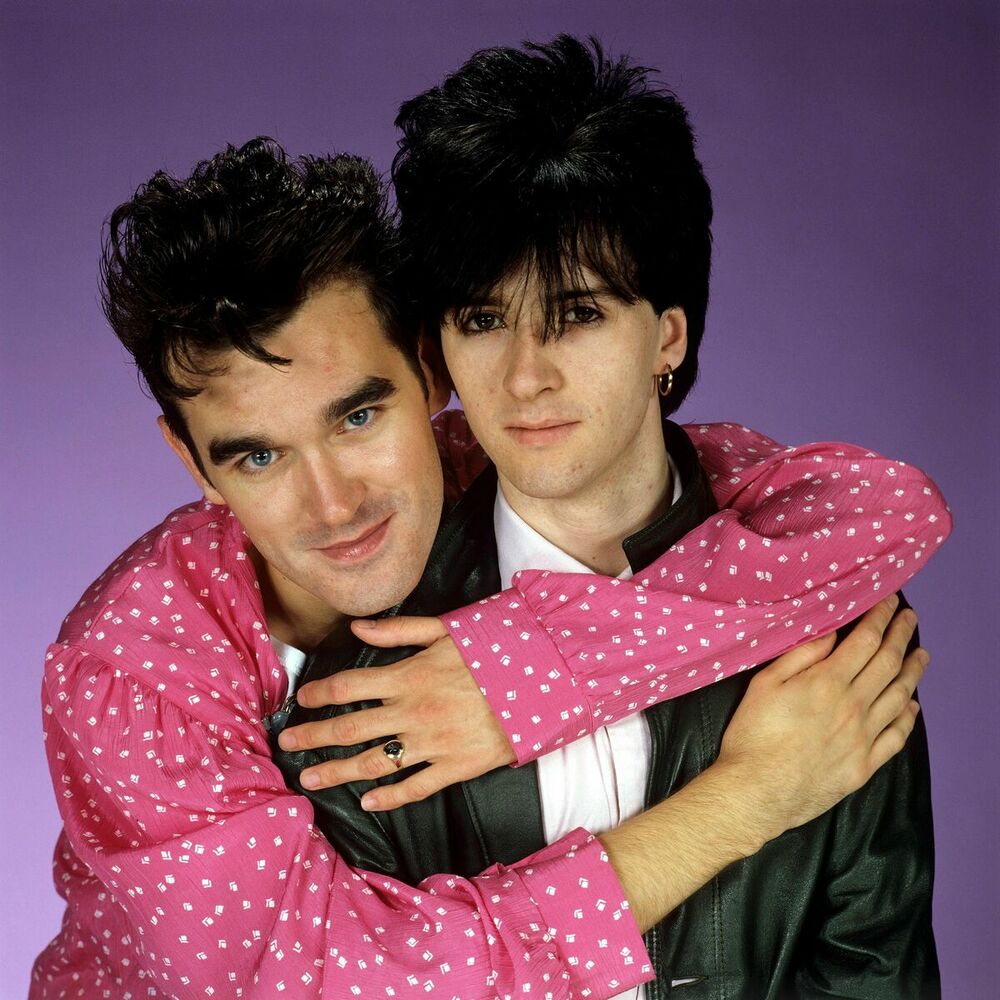
Pictured: The Smiths
← Today’s issueThe daily of where sound came fromp. 78
Born 1983 · R.E.M.'s Murmur and the Smiths
Jangle pop
The chiming, ringing guitar sound descended from The Byrds' folk-rock jangle — indie-pop's most identifiable and enduring mode, not merely a satellite of it. Where indie-pop names a whole songwriting tradition, jangle-pop names a specific guitar technique and tone: bright, treble-forward, built on arpeggios and open chords rather than power chords or distortion.
See it on the map →How it started


Big Star's #1 Record (1972) laid the actual template over a decade before the genre had a name — Alex Chilton's Byrds-descended chime married to power-pop's melodic discipline, commercially ignored at the time and canonized only in retrospect. The genre itself dates to 1983, the year R.E.M.'s Murmur and The Smiths' earliest singles arrived within months of each other on opposite sides of the Atlantic: Peter Buck's arpeggiated Rickenbacker figures gave American college radio its defining guitar sound, while Johnny Marr's more ornate, interlocking lines did the same for the UK.
I got the first two Stooges albums immediately after I got Raw Power, and I know every note and word on them.
The two scenes ran on separate tracks for most of the decade — Manchester's baggy crossover (The Stone Roses) folding the jangle into dance rhythm, a quieter British guitar-pop lineage (Echo & the Bunnymen, The Sundays) keeping it more atmospheric — before converging again in the 1990s, when The Cranberries took the same chiming vocabulary into radio-friendly territory and Belle and Sebastian's revival made explicit what had always been implicit: that jangle-pop was as much a mood as a technique.
Essential records
Start here
Murmur
 R.E.M.1983
Produced by Mitch Easter and Don Dixon at a studio in Winston-Salem, Murmur established R.E.M.'s sonic identity with unusual completeness for a debut — Michael Stipe's deliberately obscured vocals over Peter Buck's chiming Rickenbacker guitar created a texture that sounded like no other American band then operating. 'Radio Free Europe' is the definitive statement; 'Talk About the Passion' and 'Perfect Circle' demonstrate the band's range between urgency and atmosphere. Murmur served as the bridge between punk energy and pop songcraft that American independent rock needed, with a precision that seemed effortless.
No. 2
The Queen Is Dead
 The Smiths1986
Stephen Street's production gave The Queen Is Dead a rawer, more direct sound than Meat Is Murder, and it suits the material: Morrissey had never been more nakedly literary or more sharply funny, and Marr had never played with more rhythmic momentum. The title track careens through a guitar attack with Morrissey raging at the monarchy and his own desolation simultaneously; 'There Is a Light That Never Goes Out' is the pop apex, making teenage yearning feel enormous and universal. Frequently cited as the greatest British album ever made — and unlike most such claims, that is not obviously wrong.
No. 3
#1 Record
 Big Star1972
Alex Chilton and Chris Bell wrote every song in a kind of British Invasion dream — jangling guitars and melancholic harmonies with a distinctly American warmth — yet the album was commercially invisible on release, distributed so poorly it barely circulated outside Memphis. 'Thirteen' is the most nakedly beautiful teenage love song of the decade; 'In the Street' launched a dozen later bands before The Strokes rediscovered it. What the record established, though audiences didn't hear it in time, was the template for every college-radio and jangle-pop scene that followed.
No. 4
The Stone Roses
 The Stone Roses1989
John Squire's guitar — borrowing a figure from Led Zeppelin's 'Fool in the Rain' and transforming it into a defining British hook — and Reni's drumming give the album a rhythmic sophistication that most shoegaze and indie albums of the era deliberately avoided. 'She Bangs the Drums' and 'I Wanna Be Adored' are the pop peaks; the ten-minute closer 'I Am the Resurrection' demonstrates the band's capacity for extended improvisation, its funk breakdown transforming a guitar pop song into something closer to krautrock. The album announced the end of post-punk's dominance over British indie music and the beginning of Britpop's foundation.
No. 5
Reading, Writing and Arithmetic
 The Sundays1990
Harriet Wheeler's voice is the album's governing force — she conveyed emotional directness without sentimentality, a clarity that made every melody feel confided rather than performed. 'Here's Where the Story Ends' is the breakthrough, a perfect jangle-pop song with a guitar figure instantly recognizable from the first bar; 'Can't Be Sure' announces the band's ambitions with a circular guitar pattern and Wheeler's completely unaffected delivery. It arrived at the end of jangle pop's first wave and served as its clearest and most emotionally intelligent statement.
No. 6
If You're Feeling Sinister
If You're Feeling Sinister sets Stuart Murdoch's hushed, novelistic lyrics against gently orchestrated jangle-pop, each song reading almost like a short story set to a tune. "Get Me Away from Here, I'm Dying" carries that balance at its clearest, its lightly strummed verses building into a chorus that turns restlessness into something genuinely uplifting. The arrangements throughout stay understated, string and horn touches added sparingly rather than for effect. It remains the record most credited with defining an entire strand of British indie-pop that followed in its wake.
No. 7
Let's Get Out of This Country
 Camera Obscura2006
Let's Get Out of This Country wraps Tracyanne Campbell's wry, wounded lyrics in lush, string-and-horn arrangements that recall classic girl-group pop more than anything else in Glasgow's indie scene. "Lloyd, I'm Ready to Be Heartbroken" announces its wit in the title alone, Campbell's voice riding a bright, driving arrangement that makes heartbreak sound almost celebratory. The whole record balances that same tension between melancholy lyrics and genuinely joyful production throughout. It's the album that finally carried the band's small-scale charm to an audience well beyond Scotland.
No. 8
Everybody Else Is Doing It, So Why Can't We?
 The Cranberries1993
Everybody Else Is Doing It, So Why Can't We? pairs Dolores O'Riordan's aching, yodel-inflected voice with guitar lines that chime rather than crunch, giving the whole record a delicacy that belies how quickly it caught on. "Dreams" opens the album on a rising, almost weightless melody, O'Riordan's voice climbing into its upper register exactly when the song needs the lift. The production stays uncluttered throughout, leaving her vocal performance nowhere to hide and nothing in the way. It's the record that turned a college-radio favourite into a genuine international breakthrough almost by word of mouth alone.

Who plays it
American roots
Big Star predates the genre by over a decade, working out the Byrds-descended chime as a power-pop footnote; R.E.M. picked the same tone back up in 1983 and gave American college radio its defining guitar sound.
The UK wave
The genre's main scene — The Smiths' persona-and-jangle template, Manchester's baggy crossover, and a quieter, more atmospheric strand running through Liverpool and Dublin.

Twee and indie-pop's chiming inheritors
Later custodians of the same chime, filtered through Scotland's deliberately twee 1990s scene and a 2010s–2020s revival of the same guitar tone.


Where it came from, where it went
- Psychedelic pop1966
- Power pop1972
- Jangle pop1983
- Where it went