
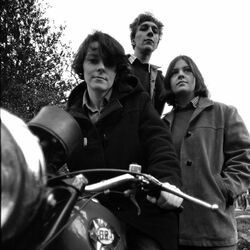
Pictured: Beat Happening
← Today’s issueThe daily of where sound came fromp. 32
Born 1986 · The NME's C86 tape and Talulah Gosh; K Records in Olympia
Twee pop
Indie pop made small and sweet on purpose: a few chords played a little too fast, untrained voices, songs about crushes and childhood sung as if nobody was listening. The word began as a sneer from the music press in the mid-1980s, and it stuck to a sound that has long outlasted the sneer.
See it on the map →How it started
 The Pastels1981
 Beat Happening1982
 Talulah Gosh1986
 Black Tambourine1989
 Heavenly1989
 Belle and Sebastian1996
In 1986 the NME gave away C86, a cassette of new British guitar bands, the Pastels among them, and its name became shorthand for a whole attitude. The Pastels had been making wobbly, tender records in Glasgow since the early 1980s, drawing on the Velvet Underground; in Oxford, Talulah Gosh set sixties girl-group tunes to the speed of the Ramones, and the press mocked them as "twee". In Olympia, Washington, Beat Happening were doing much the same on their own, three people and no bass, on Calvin Johnson's K Records.
We tried to go full [R.E.M.] Murmur / Reckoning
The sound spread through small labels more than charts: Sarah in Bristol, K in Olympia, Slumberland in Maryland, where Black Tambourine buried girl-group tunes in Mary Chain fuzz. In the 1990s it grew in two directions. Talulah Gosh's members, regrouped as Heavenly, met riot grrrl in Olympia and got louder and angrier, while Belle and Sebastian and Camera Obscura carried the hushed, literate side of it out of Glasgow to a far wider audience. Alvvays and Kero Kero Bonito show how far its sweetness has travelled since.
Essential records
Start here
If You're Feeling Sinister
If You're Feeling Sinister sets Stuart Murdoch's hushed, novelistic lyrics against gently orchestrated jangle-pop, each song reading almost like a short story set to a tune. "Get Me Away from Here, I'm Dying" carries that balance at its clearest, its lightly strummed verses building into a chorus that turns restlessness into something genuinely uplifting. The arrangements throughout stay understated, string and horn touches added sparingly rather than for effect. It remains the record most credited with defining an entire strand of British indie-pop that followed in its wake.
No. 2
Jamboree
 Beat Happening1988
Jamboree is Beat Happening at their fullest: three people, no bass, and songs that turn their limits into a style. "Indian Summer" is the one everyone knows, a hushed, swaying love song Calvin Johnson sings so plainly it sounds overheard. Elsewhere the guitars buzz and the drums thud like a garage band rehearsing, Johnson and Heather Lewis taking turns at the microphone. Kurt Cobain put it on his handwritten list of favourite albums, and its homemade sweetness has been passed down ever since.
No. 3
Was It Just a Dream?
 Talulah Gosh2013
Was It Just a Dream? collects everything Talulah Gosh recorded in their two years: singles, radio sessions and demos. Their theme song, "Talulah Gosh", sums them up, a fast, bright jangle with Amelia Fletcher's sweet voice racing the drums. Under the cuteness is a punk band, and "Break Your Face" charges like the Ramones they loved. It's the sound that gave twee pop both its name and its bite.
No. 4
Truckload of Trouble
 The Pastels1993
Truckload of Trouble gathers the Pastels' singles from 1986 to 1993, the run that made their name. The long, droning "Baby Honey" is its heart, a Velvet Underground sway over which Stephen Pastel half-sings as if thinking out loud. The playing is loose on purpose, the guitars a little out of step, and the tenderness comes through because nothing is polished away. It's the clearest record of where twee's untrained, heartfelt sound began.
No. 5
The Decline and Fall of Heavenly
 Heavenly1994
The Decline and Fall of Heavenly is the record where riot grrrl's lessons show. "Sperm Meets Egg, So What?" says it in the title alone, Amelia Fletcher's writing moved a long way from crushes into anger and argument. The guitars are louder and scrappier than on their earlier albums, while Fletcher and Cathy Rogers still trade sweet harmonies on top. It proved twee could be tough without giving up its tunes.
No. 6
Let's Get Out of This Country
 Camera Obscura2006
Let's Get Out of This Country wraps Tracyanne Campbell's wry, wounded lyrics in lush, string-and-horn arrangements that recall classic girl-group pop more than anything else in Glasgow's indie scene. "Lloyd, I'm Ready to Be Heartbroken" announces its wit in the title alone, Campbell's voice riding a bright, driving arrangement that makes heartbreak sound almost celebratory. The whole record balances that same tension between melancholy lyrics and genuinely joyful production throughout. It's the album that finally carried the band's small-scale charm to an audience well beyond Scotland.
No. 7
Black Tambourine
 Black Tambourine2010
Black Tambourine collects nearly everything the band recorded, a dozen-odd songs that fit on one record with room to spare. "Throw Aggi Off the Bridge" is the best known, a bright girl-group tune sung deadpan by Pam Berry and drowned, Mary Chain style, in distortion. The recordings are cheap and the fuzz is thick, which is exactly the point: the sweetness sounds sharper through the noise. Few bands have shaped a sound with so little.

Who plays it
The founders
Glasgow, Oxford, Olympia and suburban Maryland in the mid-to-late 1980s: bands who chose to sound small, sweet and homemade, and the tiny labels that put them out.
Growing up
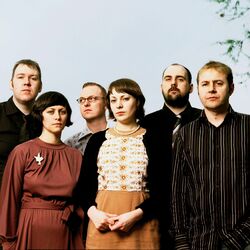
In the 1990s the sound went two ways: Heavenly got louder after meeting riot grrrl in Olympia, while Belle and Sebastian and Camera Obscura made it hushed, literate and orchestral.
Where it went next
Twee's sweetness carried into newer music: Alvvays' jangle under a dream-pop haze, and Kero Kero Bonito's playground melodies made on laptops.


Where it came from, where it went
Nothing on the map has grown out of it yet.