
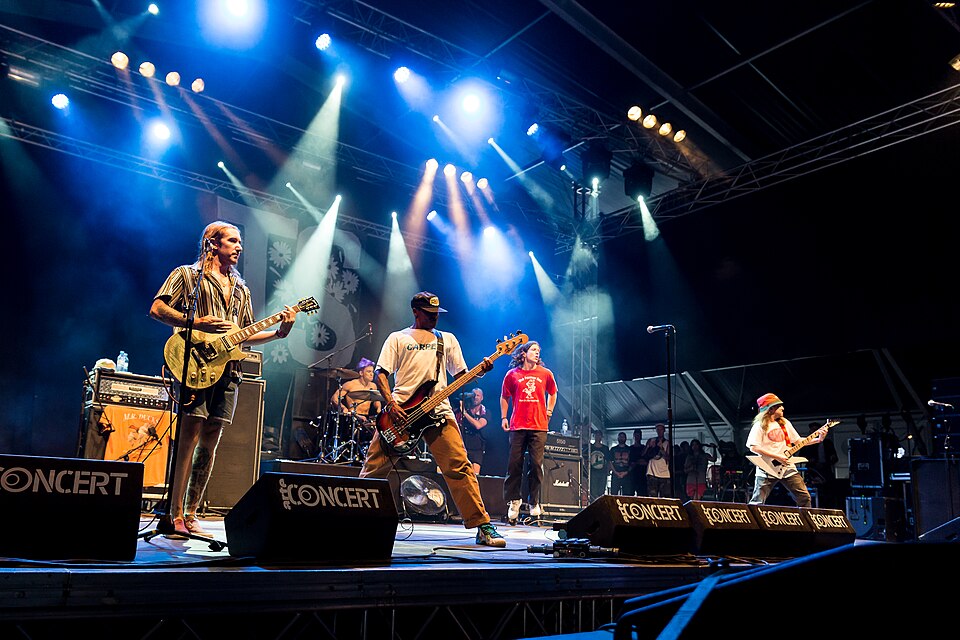
Pictured: Black Flag
← Today’s issueThe daily of where sound came fromp. 18
Born 1980 · Black Flag, Nervous Breakdown
Hardcore punk
Punk sped up, stripped down, and made even more hostile to the mainstream — shorter songs, faster tempos, and a DIY touring circuit built out of necessity after almost no club would book the bands. Hardcore is where punk's original confrontation got even more literal.
See it on the map →How it started


Black Flag's Nervous Breakdown EP in 1980 set the template: songs under two minutes, barked vocals, and a relentless, self-booked national touring circuit that ran through basements and VFW halls because nothing else was available. That DIY infrastructure — more than any single sound — is what actually defines the genre; it's how a scene this confrontational sustained itself without radio or major labels.
We were influenced by the Stooges and then the Ramones; they inspired us.
A parallel, tightly connected scene was doing much the same thing in Washington, DC, centered on Ian MacKaye's Dischord label and Minor Threat's straight-edge discipline. Hardcore's most direct descendants — post-hardcore and emo, both genres in this map in their own right — grew straight out of these same DC and LA circles. Its wider downstream, pop-punk and metalcore, is real but deliberately outside this map's scope.
Essential records
Start here
Damaged
 Black Flag1981
Damaged is the sound of hardcore arriving at full, controlled fury: Greg Ginn's guitar lurches between sludge and jagged dissonance while Henry Rollins, in his first album with the band, sounds like he's barely containing something much larger than the song. "Rise Above" turns defiance into a genuine anthem, its gang-vocal chorus built for rooms that were about to erupt. "TV Party" proves the band could be viciously funny without losing any of its edge. Decades on, it still sounds like a documented act of aggression rather than a period piece.
No. 2
Bad Brains
 Bad Brains1982
Bad Brains plays like a dare: hardcore delivered at a speed and precision that few bands of the era could touch, then interrupted by reggae interludes that somehow never break the record's momentum. "Banned in D.C." turns the band's own real-life exile from DC's club circuit into a defiant statement of purpose, H.R.'s vocals swinging between a hardcore bark and a reggae croon within the same verse. "Sailin' On" and "Big Take Over" show a rhythm section playing at a level of tightness closer to jazz fusion than punk. It's the rare hardcore record where the musicianship is as startling as the aggression.
No. 3
Complete Discography
 Minor Threat1989
This compilation gathers every Minor Threat recording — the two early EPs, the In My Eyes 7-inch, and the Out of Step LP — into the single most complete document of a band that lasted barely three years and changed American hardcore permanently. Ian MacKaye's brief, blunt songs set the template for the entire DC scene and, entirely by accident, for a whole straight-edge subculture. 'Straight Edge' runs forty-six seconds and coined the movement's name in the process, though MacKaye has said he never intended to start one. Nearly every fast, short, furious hardcore band since owes it a direct debt.
No. 4
Fresh Fruit for Rotting Vegetables
 Dead Kennedys1980
Fresh Fruit for Rotting Vegetables turns hardcore into satire without softening any of its speed or aggression. "Holiday in Cambodia" pairs East Bay Ray's twangy, surf-warped guitar with Jello Biafra's sneering indictment of privileged complacency, the tension between the music's catchiness and the lyric's savagery never resolving. "Kill the Poor" and "California Über Alles" show the same trick used against different targets, each one landing as both a genuine political statement and a dark joke. Few hardcore records have aged into being this quotable.
Who plays it
DC and its lineage
Ian MacKaye's Dischord scene and the straight-edge discipline it built — a lineage that runs unbroken enough to reach Turnstile's Baltimore-adjacent update decades later.


LA and the SST circuit
Greg Ginn's SST Records and the Southern California scene that built hardcore's national touring circuit out of nothing.

Beyond the coasts
Hardcore took hold everywhere the touring circuit reached — San Francisco, Minneapolis, Vancouver, Umeå — proof the sound never needed a single hometown.

Into metallic hardcore
In the 1990s hardcore met metal's weight and jazz's time signatures: Converge turned it on their own lives, and the Dillinger Escape Plan pushed it into chaos they wanted to feel like the first time they saw Bad Brains and Black Flag.


Where it came from, where it went
- Garage rock1963
- Proto-punk1967
- Punk1976
- Hardcore punk1980
- Where it went