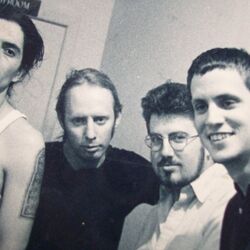
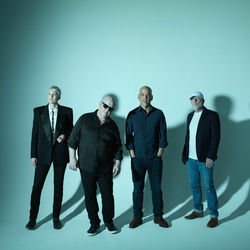
Tap any face to see why they're in the photo

Who shaped them

Pixies

Pixies

Since 1986 · United States

The Pixies arrived from Boston in 1987 with a template that Kurt Cobain later named explicitly… Their story

See them on the map

Press ▶︎ to play

Loading…

It really plays! Press the middle

Who they shaped

Behind them, left to right: Black Flag, Talking Heads, Violent Femmes, The Jesus and Mary Chain, Gang of Four, Hüsker Dü, R.E.M., The Velvet Underground, Sonic Youth, David Bowie.

In front, left to right: Radiohead, Nirvana, Modest Mouse, At The Drive-In, Slowdive, Fontaines D.C., Arcade Fire, Ride, yeule, Spoon.

The bigger the face, the stronger the proof: they said it themselvesreporteda critic, or widely accepted

Doolittle cover

Start here

Doolittle (1989)

The compromise between Steve Albini's raw approach on Surfer Rosa and Gil Norton's more polished production gave Doolittle the band's most commercially accessible sound without sacrificing the extremity that made Surfer Rosa essential. Black Francis's compositional approach — verses at a whisper, choruses at a scream, structures that expand and contract without warning — is most explicitly showcased on 'Here Comes Your Man' and 'Gouge Away.' Kurt Cobain cited the record directly when explaining Nirvana's quiet-loud dynamic.

Sleeve notes

Pixies

Doolittle · 1989

The Pixies arrived from Boston in 1987 with a template that Kurt Cobain later named explicitly: quiet/loud dynamics, melodic verses detonating into distorted choruses, lyrics that were alternately surrealist and directly violent, and Frank Black's extraordinary guitar-player-disguised-as-frontman at the center. Surfer Rosa (1988), produced by Steve Albini with a characteristic refusal of polish, and Doolittle (1989), their commercial peak, together described a new grammar for guitar rock that the mainstream would eventually catch up to.

The Pixies' influence on Nirvana is documented; their influence on British shoegaze is less discussed but equally real — the idea that pop melody could coexist with noise, that a song could be beautiful and ugly in the same measure, runs from the Pixies through My Bloody Valentine and beyond. Black Francis's lyrics, which suggested elaborate mythologies without providing them, and Kim Deal's bass — half-melodic, half-counterpoint — gave the band a tension that no subsequent reunion has quite reproduced. Deal also led her own band, the Breeders, from 1989.


Since 1986 · United States

Played at

4AD

London · 1980–1995

On the bill

The roster's outlier — loud, American, produced by Steve Albini in direct opposition to the label's reputation for gauze — signed by Watts-Russell anyway, proof the 4AD ear was never just a genre rule.

The whole scene