
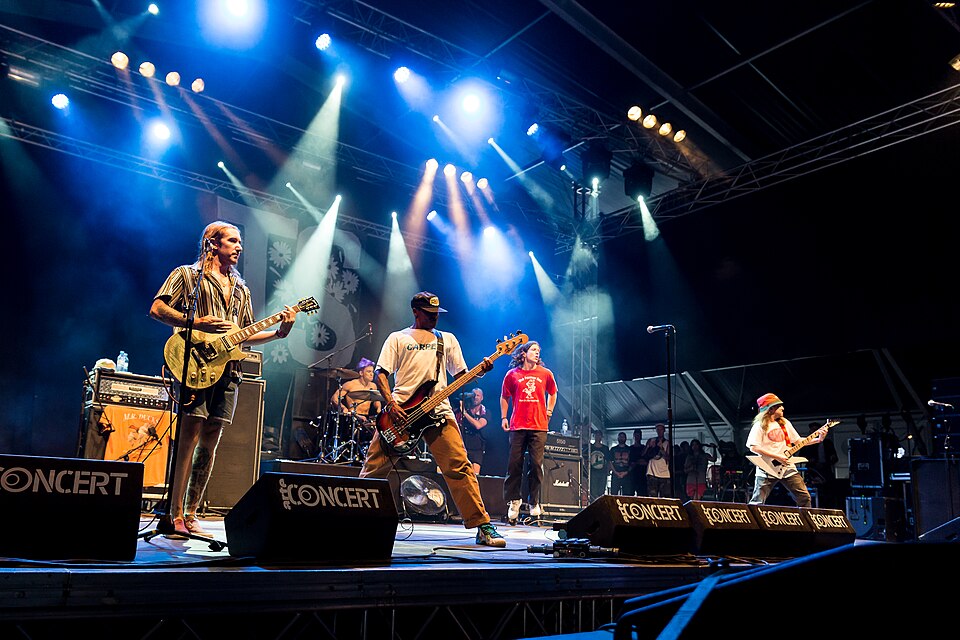
Pictured: Fugazi
← Today’s issueThe daily of where sound came fromp. 30
Born 1985 · Rites of Spring and Big Black
Post-hardcore
Hardcore's own art-school turn — the same DIY intensity, aimed at something more structurally adventurous than a two-minute blast. Post-hardcore kept the volume and the confrontation but let in dissonance, start-stop dynamics, and songs that don't necessarily resolve.
See it on the map →How it started


Big Black's Atomizer (1986) and Rites of Spring's self-titled EP (1985) — the latter a Dischord release by musicians who'd already been through DC's hardcore scene once — pointed in different but related directions: Big Black toward mechanized, industrial-tinged noise, Rites of Spring toward something more emotionally exposed. That second direction eventually split off entirely into emo, covered on its own page; this one follows the harder, more angular half of the split.
As a musician, I was formed by being embedded in the Punk scene,
The Dischord label kept threading through the genre's next decade via Fugazi, while an entirely separate noise-rock-adjacent scene in Chicago (Steve Albini's Big Black, then The Jesus Lizard) and math-rock-inflected bands in Louisville (Slint) and San Diego (Drive Like Jehu) pushed the sound in harder, more dissonant directions with little direct contact between them.
Essential records
Start here
Repeater
 Fugazi1990
Fugazi's first full-length distilled Ian MacKaye and Guy Picciotto's dual-vocal, dub-inflected post-hardcore into a manifesto for both the sound and the band's DIY ethics. 'Merchandise' turns anti-consumerist anger into one of the tightest, most controlled songs in the catalog, alternating clenched verses with an explosive chorus. The interplay between MacKaye's rhythm guitar and Picciotto's lead lines already sounds like a conversation rather than an arrangement. It set the template — musically and ethically — for the DC scene's next decade and for post-hardcore far beyond it.
No. 2
Spiderland
 Slint1991
Spiderland moves at the pace of a held breath: long stretches of quiet, interlocking guitar figures suddenly broken by eruptions of noise that feel less like choruses than controlled detonations. "Good Morning, Captain" builds a spoken-word narrative of guilt and drowning toward a final scream that remains one of the most viscerally effective moments in American underground rock. Brian McMahan's murmured vocals and David Pajo's spidery guitar lines create a sense of narrative dread the band never has to spell out. Barely noticed on release, it became the foundational text for post-rock's whisper-to-roar dynamics.
No. 3
Rites of Spring
 Rites of Spring1985
Rites of Spring takes hardcore's urgency and turns it inward, trading political fury for something closer to open vulnerability. "For Want Of" builds around Eddie Janney's melodic, almost jangling guitar lines while Guy Picciotto's vocals swing between a hardcore bark and something closer to a confession. The band broke up within about a year of forming, leaving this self-titled record as their only real statement. It's now credited, somewhat against Picciotto's own wishes, as the record where emo as a genre effectively begins.
No. 4
Atomizer
 Big Black1986
Atomizer runs on a drum machine's inhuman precision, Steve Albini layering scraping, distorted guitar over its mechanical pulse until the combination feels genuinely unsettling rather than merely harsh. "Kerosene" turns small-town boredom and arson into a flat, matter-of-fact narrative, the calm of the delivery making the content more disturbing rather than less. The record's industrial-tinged noise rock set a template Albini himself would go on to help engineer for other bands. Nearly forty years later, its coldness hasn't dated at all.
No. 5
Goat
 The Jesus Lizard1991
Goat pairs David Yow's genuinely unhinged vocal presence with a rhythm section disciplined enough to make the chaos feel engineered rather than accidental. "Mouth Breather" rides a lurching, off-kilter riff from Duane Denison while David Wm. Sims's bass anchors the whole song against collapse. Steve Albini's dry, unglamorous production strips away any hint of studio polish, leaving the band's menace fully exposed. It's an album that sounds dangerous specifically because the musicianship underneath it is so tightly controlled.
No. 6
Yank Crime
 Drive Like Jehu1994
Yank Crime stretches post-hardcore's aggression across song structures built more like prog-rock architecture than punk's usual three-chord blast. "Here Come the Rome Plows" spends nearly nine minutes alternating tension and detonation, John Reis and Rick Froberg's two guitars circling each other in dissonant counterpoint rather than doubling a single riff. The band's only studio album, it never repeats a trick across its entire runtime. Two decades on, its unresolved, careening structures still read as a challenge other bands are trying to answer.
No. 7
Relationship of Command
 At The Drive-In2000
Relationship of Command captures At the Drive-In at the exact point where their chaos and their songwriting were in perfect balance. "One Armed Scissor" rides a tense, start-stop riff into a chorus built for a room already coming apart, Cedric Bixler-Zavala's vocal veering between melody and outright shriek. Omar Rodríguez-López's guitar work throughout suggests a band constantly on the verge of losing control without ever actually doing so. The band splintered into Sparta and The Mars Volta almost immediately after, leaving this as the sound of a group at its absolute peak.
No. 8
The Shape of Punk to Come
 Refused1998
The Shape of Punk to Come sets out, in its title alone, to reject hardcore's own conservatism, and the album delivers on the dare: electronic samples, free-jazz saxophone, and dance rhythms folded into songs that never lose their hardcore force. "New Noise" builds from a tense, near-silent verse into one of the genre's most explosive choruses, Dennis Lyxzén's vocal alternating between a whisper and a full-throated demand. The band broke up almost immediately after the album's release, touring it only briefly. Its reputation has only grown since, turning a record largely ignored on arrival into one of hardcore's most cited genre-fusion statements.
No. 9
Source Tags & Codes
 ...And You Will Know Us by the Trail of Dead2002
Source Tags & Codes channels Trail of Dead's usual maximalism into something genuinely unified: swelling strings, interlocking dual drums from Conrad Keely and Jason Reece, and vocal performances pitched at full intensity throughout. "Another Morning Stoner" builds gradually from a spare, melodic opening into one of the record's most cathartic peaks, never rushing the transition. The album's scope and ambition set it apart from the more compact structures favored by most of the band's post-hardcore peers. It remains the clearest single argument for combining hardcore's force with art-rock's structural reach.
Who plays it
The Dischord wing
Ian MacKaye's DC label stayed the genre's throughline for a decade — Fugazi took hardcore's discipline and slowed it into something more dub-influenced and controlled, while The Dismemberment Plan pushed the same scene toward something quirkier and more danceable.

Noise and math-rock crossover
The genre's harder, more dissonant wing — Chicago noise (Big Black, The Jesus Lizard), Louisville and San Diego's math-rock-adjacent bands (Slint, Drive Like Jehu), and a scattering of others who arrived at the same jagged intensity independently.


The modern chapter
Post-hardcore's most recent, genre-blurring update — Turnstile folds in R&B and shoegaze without losing the genre's physical intensity.
Into emo
Where post-hardcore's angularity turns melodic and confessional. These three carry both tags, and the fuller story of that turn is told on emo's own page.


Where it came from, where it went
- Garage rock1963
- Proto-punk1967
- Punk1976
- Hardcore punk1980
- Post-hardcore1985
- Where it went