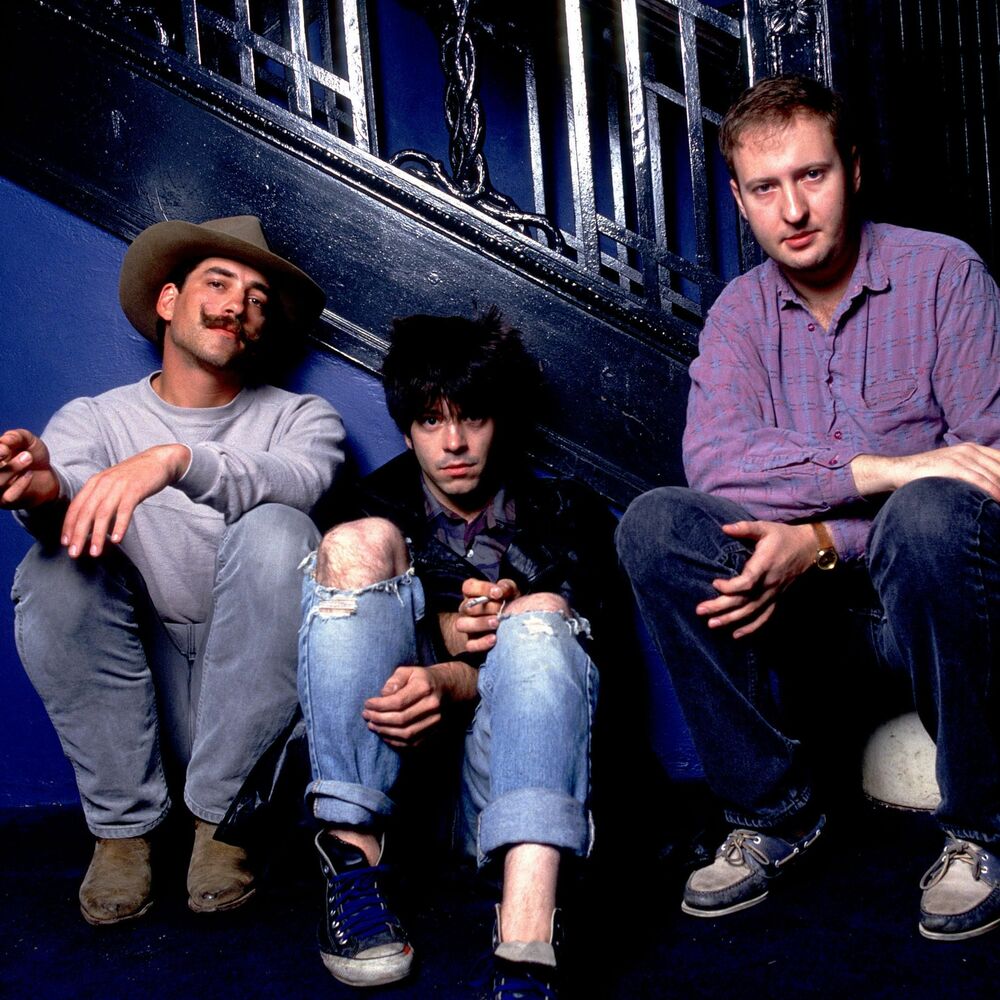
Pictured: Hüsker Dü
← Today’s issueThe daily of where sound came fromp. 28
Born 1985 · The Jesus and Mary Chain, Psychocandy
Noise pop
Pop melody run straight through a wall of guitar feedback — hooks intact, but coated in distortion instead of polished clean. Noise-pop is a small, tightly-sourced lineage with one shared point of origin.
See it on the map →How it started


The Jesus and Mary Chain's Psychocandy (1985) is the record that essentially invents the genre in one move — Velvet Underground-style drones and Phil Spector-style pop structure, both submerged under a level of guitar feedback that was closer to provocation than production polish at the time. Hüsker Dü were working a related but independent angle a year earlier: Zen Arcade (1984) took a hardcore-punk band's speed and volume and pointed it, unexpectedly, at real melody and pop songcraft.
Pete Shelley is like one of the main influences on my work.
The two records share almost nothing in scene or geography — Scottish art-school provocateurs versus a Minneapolis hardcore band pushing past its own genre's limits — but both arrive at the same idea from opposite directions: bury a genuine pop song under more noise than pop is supposed to tolerate. Shoegaze, the wall-of-sound genre noise-pop is most often mentioned alongside, descends in this map from dream-pop's hazier lineage rather than directly from noise-pop — but Psychocandy is the record both genres point back to as a starting shot, whichever branch of the tree they're filed under.
Essential records
Start here
Psychocandy
The Jesus and Mary Chain buried the most straightforwardly melodic songwriting impulses in British music under a wall of feedback and cassette-quality distortion — and the melodies are good enough to survive the treatment. 'Just Like Honey' carries one of the decade's most immediately affecting vocal melodies on a drum-machine thump and feedback wash; 'Never Understand' demonstrates the more aggressive pole. It created the template for noise-pop — aggressive sound design as a vehicle for romantic songwriting — that My Bloody Valentine and two decades of indie bands would inherit.
No. 2
Last Splash
 The Breeders1993
Last Splash turns Kim Deal's gift for the deceptively simple hook loose over a rhythm section that never quite sits still, lurching between surf-rock, sludge and something close to pop. "Cannonball" is the one everyone knows -- built on a rubbery bassline and a distorted vocal intro that sounded like nothing else on 1993 radio -- but "Divine Hammer" and "Saints" work the same instinct at different speeds. Josephine Wiggs's bass carries more melody than most bands give their guitars. It remains the rare album that went platinum without smoothing away a single one of its odd edges.
No. 3
Zen Arcade
 Hüsker Dü1984
Hüsker Dü's double album came from a continuous recording session, largely improvised and self-produced, which gives it an urgency no major-label production could have achieved — the songs feel captured rather than constructed. Bob Mould and Grant Hart are equal songwriting forces across 23 tracks, Mould pushing toward melody and Hart toward emotional directness, including Hart's 'Pink Turns to Blue,' a devastating account of a friend's overdose. It effectively ended hardcore as the dominant mode of American underground music by demonstrating that its energy could accommodate complexity.
No. 4
Black Tambourine
 Black Tambourine2010
Black Tambourine collects nearly everything the band recorded, a dozen-odd songs that fit on one record with room to spare. "Throw Aggi Off the Bridge" is the best known, a bright girl-group tune sung deadpan by Pam Berry and drowned, Mary Chain style, in distortion. The recordings are cheap and the fuzz is thick, which is exactly the point: the sweetness sounds sharper through the noise. Few bands have shaped a sound with so little.

Who plays it
Two roads to the same wall of sound
Separated by scene, geography, and starting genre — Scottish art-provocation versus Minneapolis hardcore — but arriving within a year of each other at the same basic move: real pop songs, buried under more distortion than pop is supposed to carry.
The girl-group wing
Psychocandy's lesson taken literally in suburban Maryland: sixties girl-group tunes, sung sweet and flat, drowned in fuzz on a shoestring. A few singles that became a template for American noise pop and twee alike.
Where it came from, where it went
Nothing on the map has grown out of it yet.