
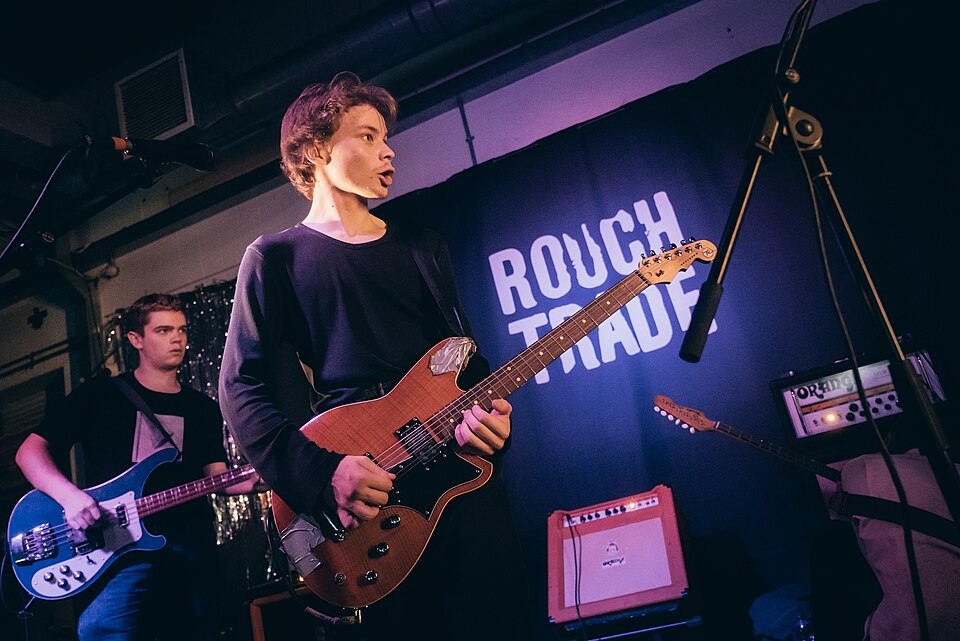
Pictured: Drive Like Jehu
← Today’s issueThe daily of where sound came fromp. 50
Born 1994 · Drive Like Jehu, Yank Crime
Math rock
Rock rebuilt around interlocking, irregular-meter guitar geometry instead of riffs or hooks — precision and unusual time signatures treated as the point, not an obstacle to a song. Math-rock grew out of post-hardcore's harder edge and has kept resurfacing wherever a band gets more interested in counting than in choruses.
See it on the map →How it started
 Slint1986
 Drive Like Jehu1990
 At The Drive-In1994
 American Football1997
 The Dillinger Escape Plan1997
 Pinback1998
The sound predates its name by a few years — Slint's Spiderland (1991), whisper-quiet verses breaking into abruptly counted riffs, is retroactively cited as close to a founding document, even though nobody called it math-rock at the time. The term itself dates to 1994, applied to San Diego's Drive Like Jehu and their album Yank Crime, whose knotted, start-stop guitar interplay and irregular meters made the label's implication — a rock band doing arithmetic — feel literal rather than jokey.
Well, if you’re talking about Drive Like Jehu, bands we’re always citing are The Wipers
The style has never settled into one geography or era, resurfacing from Texas's post-hardcore scene (At the Drive-In) through Japan's own instrumental tradition (toe) and into 2010s–2020s London (black midi). Its closest relative, midwest emo's twinkly guitar interplay, shares real DNA with math-rock and gets its own page rather than a repeat here — American Football carries both tags.
Essential records
Start here
Spiderland
 Slint1991
Spiderland moves at the pace of a held breath: long stretches of quiet, interlocking guitar figures suddenly broken by eruptions of noise that feel less like choruses than controlled detonations. "Good Morning, Captain" builds a spoken-word narrative of guilt and drowning toward a final scream that remains one of the most viscerally effective moments in American underground rock. Brian McMahan's murmured vocals and David Pajo's spidery guitar lines create a sense of narrative dread the band never has to spell out. Barely noticed on release, it became the foundational text for post-rock's whisper-to-roar dynamics.
No. 2
Yank Crime
 Drive Like Jehu1994
Yank Crime stretches post-hardcore's aggression across song structures built more like prog-rock architecture than punk's usual three-chord blast. "Here Come the Rome Plows" spends nearly nine minutes alternating tension and detonation, John Reis and Rick Froberg's two guitars circling each other in dissonant counterpoint rather than doubling a single riff. The band's only studio album, it never repeats a trick across its entire runtime. Two decades on, its unresolved, careening structures still read as a challenge other bands are trying to answer.
No. 3
American Football
American Football trades the hardcore urgency of the band members' earlier projects for something quieter and more intricate: twinkling, interlocking guitar lines, jazz-inflected chords, and trumpet drifting through the mix. "Never Meant" builds a whole song out of a single conversational guitar figure, Mike Kinsella's plainspoken vocal sitting almost shyly in the mix rather than out front. The band broke up shortly after its release, with little sense the record would be remembered. Rediscovered over the following decade, it became one of the most quietly influential albums in the midwest-emo and "twinkly" post-rock scenes that followed.
No. 4
The Book About My Idle Plot on a Vague Anxiety
 toe2005
The Book About My Idle Plot on a Vague Anxiety builds entirely instrumental songs out of interlocking, technically demanding guitar lines that never feel merely cerebral. "Goodbye" pairs a rippling, melodic guitar figure with busy, propulsive drumming, the two constantly trading momentum without ever losing the song's emotional pull. Where much of instrumental math rock prizes complexity for its own sake, toe keep every part in service of an actual melody. It's an album that made the genre's technicality feel warm rather than academic.
No. 5
Relationship of Command
 At The Drive-In2000
Relationship of Command captures At the Drive-In at the exact point where their chaos and their songwriting were in perfect balance. "One Armed Scissor" rides a tense, start-stop riff into a chorus built for a room already coming apart, Cedric Bixler-Zavala's vocal veering between melody and outright shriek. Omar Rodríguez-López's guitar work throughout suggests a band constantly on the verge of losing control without ever actually doing so. The band splintered into Sparta and The Mars Volta almost immediately after, leaving this as the sound of a group at its absolute peak.

Who plays it
The founding wave
Math-rock's actual originators, all working out of post-hardcore's harder edge between 1991 and 2000 — Slint's hushed dread, Drive Like Jehu's knotted San Diego riffing, At the Drive-In's more song-structured update a decade later.
Global and later variations
The sound scattered well past its American post-hardcore roots — Japan's toe built an entire instrumental tradition around it, San Diego's Pinback folded it into something poppier, and London's black midi pushed the same geometry toward 2020s art-rock excess.

Into midwest emo
Where math-rock's interlocking guitar work crosses into emo's confessional territory. American Football carries both tags, and gets the fuller telling on midwest emo's own page.
Where it came from, where it went
Nothing on the map has grown out of it yet.