
Pictured: Galaxie 500
← Today’s issueThe daily of where sound came fromp. 42
Born 1990 · Codeine, Low and Galaxie 500
Slowcore
Indie rock slowed to a crawl — hushed vocals, minimal arrangement, and tempos that dare a listener's patience. Slowcore takes rock instrumentation and empties out almost everything but space and dynamics.
See it on the map →How it started
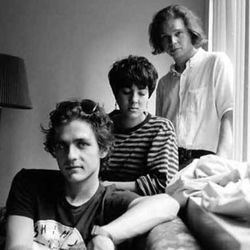





Codeine's Frigid Stars LP established the basic method in 1990: rock's standard trio, played at a fraction of the expected tempo, with reverb and empty space doing as much work as any note played. Low, forming in Duluth, Minnesota that same year, pushed the minimalism furthest — hushed harmony vocals over a barely-there drum kit, volume kept deliberately low even live. Galaxie 500 is often named alongside both as a third founding reference, though in this map they carry a dream-pop tag rather than a slowcore one.
We were listening to the Velvet Underground's self-titled third album-- almost to a crazy extreme.
Mark Kozelek's Red House Painters brought a more baroque, string-laden version of the same patience, and the sound has stayed a small, quietly persistent undercurrent since — resurfacing in Cat Power's hushed early records and, decades later, in Phil Elverum's Mount Eerie, which pushed the minimalism toward something closer to drone.
Essential records
Start here
On Fire
 Galaxie 5001989
On Fire moves at a hushed, unhurried pace, built from simple chord changes and Dean Wareham's plaintive, untrained vocal floating over reverb-drenched guitar. The record's patience and minimalism ran directly against the noisier American underground surrounding it at the time, drawing instead on the quiet, self-titled third Velvet Underground album and Jonathan Richman's Modern Lovers as templates. Nothing on the record reaches for a hook in any conventional sense, trusting mood and repetition instead. It became the direct template for the slowcore lineage that followed, a debt Low and others have credited by name.
No. 2
Frigid Stars LP
 Codeine1990
Frigid Stars LP moves at a pace that turns near-silence into its own kind of tension, each guitar note given space to fully decay before the next one arrives. "D" builds almost nothing by conventional standards — a slow chord change, a hushed vocal — yet the accumulated weight of that restraint hits harder than most louder records manage. The album helped define what would later be labeled slowcore, a genre built on exactly this kind of patience. Decades on, its influence turns up in bands who never play anything resembling hardcore, yet trace their hushed pacing directly back here.
No. 3
Things We Lost in the Fire
 Low2001
Produced by Steve Albini, Things We Lost in the Fire keeps Low's tempos as unhurried as ever while letting the arrangements breathe more fully than on earlier, sparser records. "Sunflower" builds a whole song around Sparhawk and Parker's close, intertwined harmonies over patient, minimal guitar, never rushing toward a payoff that a louder band would have forced. "Dinosaur Act" shows the same patience applied to something darker and more ominous. It's a record that demonstrates exactly why slowness, handled with this much control, never reads as a lack of intensity.
No. 4
Red House Painters I
The self-titled 1993 debut, universally known as Rollercoaster for its cover, stretches out at a pace few rock records of its era attempted, several songs running well past six minutes on the strength of patience alone rather than any buildup toward a climax. "Katy Song" moves at a near-stationary tempo, Kozelek's voice sitting just above a murmur over slowly shifting guitar chords, the melody taking its time to reveal itself. "Have You Forgotten" shows the same unhurried approach applied to something closer to a lament. It's a record that helped define what would later be called slowcore — extended, spacious, and almost entirely unconcerned with momentum.
No. 5
Stratosphere
 Duster1998
Stratosphere sounds deliberately unfinished: hazy four-track fidelity, guitars that drift rather than announce themselves, vocals mixed low enough to function more as texture than message. "Inside Out" moves at an unhurried pace, its melody only gradually revealing itself under layers of tape hiss and reverb. The whole album feels less like a set of songs than a mood sustained across a whole side. Barely noticed on release, it found a much larger audience decades later, once a new generation caught up to its patience.

Who plays it
Slowcore's core lineage
A small, coherent scene rather than a genre with real internal factions — Codeine and Low set the template in 1990, Red House Painters gave it strings, and Cat Power and Mount Eerie carried the same patience into the following two decades.

Where it came from, where it went
Nothing on the map has grown out of it yet.