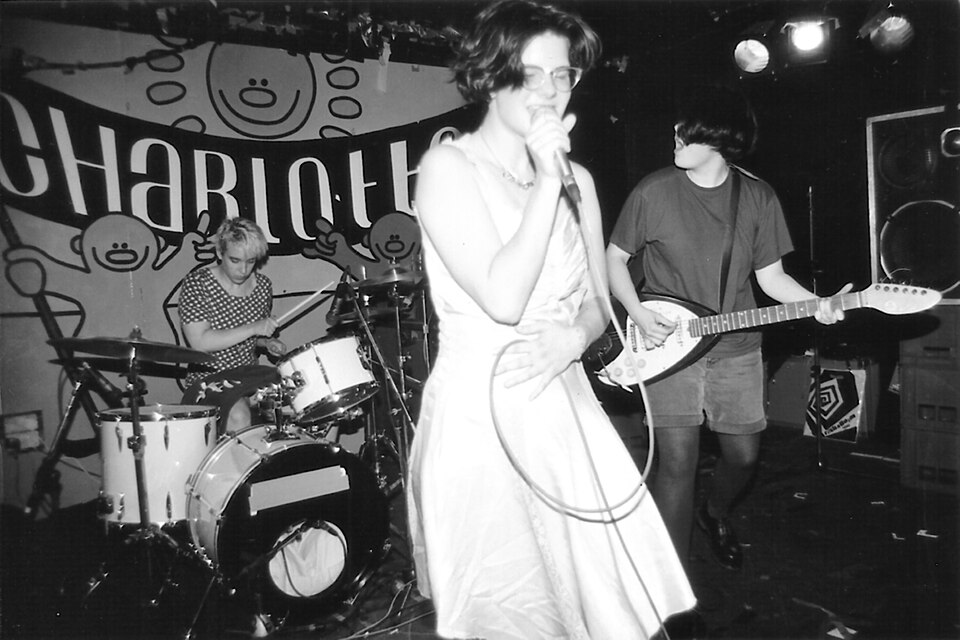
Pictured: Bratmobile
← Today’s issueThe daily of where sound came fromp. 44
Born 1991 · Bikini Kill and the Olympia scene
Riot grrrl
Feminist punk's most explicitly political wave — DIY zines, confrontational live sets, and lyrics that made gendered violence and access to the stage central subject matter rather than subtext. Riot grrrl grew out of one specific place and moment, Olympia, Washington in the early 1990s, before spreading into a loose, self-organized national network.
See it on the map →How it started


Bikini Kill formed in Olympia in 1990, and Kathleen Hanna's zine writing the following year gave the movement its name and its founding document — a call for girls to start bands, start zines, and route around the punk scene's boy's-club gatekeeping rather than politely ask to join it. Bratmobile, forming in Olympia that same year, ran a parallel track, releasing 1993's Pottymouth as a scrappier, more overtly pop-damaged take on the same confrontational instinct.
The Slits have been hugely influential on me.
Sleater-Kinney arrived slightly later, in 1994, growing directly out of that Olympia scene's DIY, explicitly feminist tradition without ever quite settling inside its boundaries — Corin Tucker and Carrie Brownstein's interlocking guitars pushed the sound toward something more structurally ambitious than riot grrrl's founding bands had attempted. The movement's reach extended well beyond what this map currently tracks: Huggy Bear carried the UK's own answer to the scene, and Heavens to Betsy — Corin Tucker's band before Sleater-Kinney — worked the same Olympia circuit from its earliest days, both real riot grrrl acts sitting outside this map's current roster.
Essential records
Start here
Pussy Whipped
 Bikini Kill1993
Pussy Whipped strips its arrangements down to blunt, insistent hooks, giving Kathleen Hanna's confrontational lyrics nowhere to hide behind studio polish. "Rebel Girl" is the album's clearest statement, its chanted chorus turning admiration between women into a genuine anthem, driven by a simple, driving riff that never lets up; the song exists in more than one recorded version, including one produced by Joan Jett herself. The whole record favours directness over nuance, treating that bluntness as a political choice rather than a limitation. It remains the song and the album most identified with riot grrrl's entire founding moment.
No. 2
Dig Me Out
 Sleater-Kinney1997
Dig Me Out tightens Sleater-Kinney's interlocking guitar interplay into some of the most urgent songwriting of their career, Corin Tucker and Carrie Brownstein's voices overlapping in tense, unresolved harmony. The title track sets the tone immediately, Janet Weiss's drumming — her first record with the band — giving the songs a propulsive backbone the earlier records sometimes lacked. Nothing about the arrangement relies on a bassist to hold the low end down; the two guitars do all the structural work themselves. It's the album most responsible for establishing Sleater-Kinney as one of the decade's defining American punk bands.
No. 3
Pottymouth
Bratmobile1993Pottymouth runs its songs fast and loose, Allison Wolfe's yelped, conversational vocal riding deliberately scrappy garage-pop arrangements that never aim for polish. "Cool Schmool" carries the album's wit at its sharpest, turning teenage social anxiety into something genuinely funny without losing its bite. The whole record sounds like it was recorded in a single excited take, an urgency that studio refinement would only have dulled. It stands as one of riot grrrl's clearest full-length statements, as much a document of a scene's ethos as a collection of songs.
Who plays it
Olympia's founding network
Riot grrrl was never one band so much as a scene organized entirely on its own terms — Bikini Kill's founding manifesto, Bratmobile's parallel Olympia circuit, and Sleater-Kinney's slightly later, more structurally ambitious arrival, all growing out of the same DIY network.
Where it came from, where it went
- Garage rock1963
- Proto-punk1967
- Punk1976
- Riot grrrl1991
Nothing on the map has grown out of it yet.