
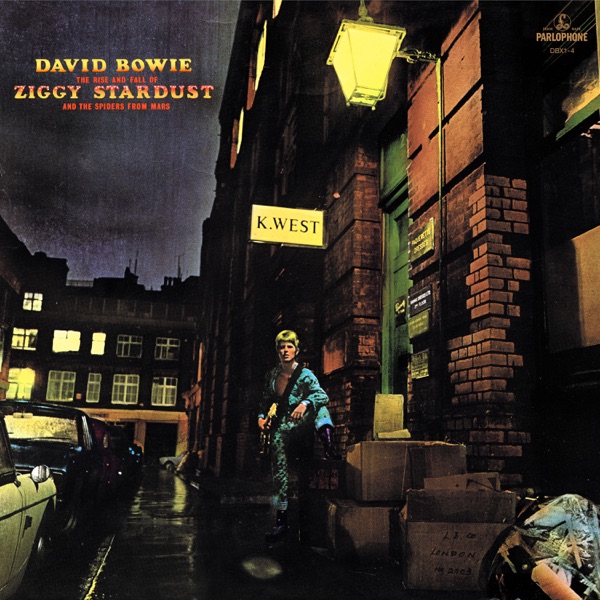
Sleeve notes
David Bowie
The Rise and Fall of Ziggy Stardust and the Spiders from Mars · 1972
David Bowie is many artists — the glam-rock alien, the blue-eyed soul singer, the Berlin experimentalist, the eighties pop icon, the nineties drum-and-bass enthusiast — and the problem with writing about him is deciding which one to begin with. The one who matters most to this graph is the Bowie of 1976–1979: the Berlin trilogy made with Brian Eno, Low, Heroes, and Lodger, records that dismantled the song's structure and reassembled it as something else. Side two of Low in particular — instrumentals named like emotional states, each one a complete thing — is one of the most radical moves a mainstream pop artist had made to that point.
But the through-line of influence is longer than the Berlin period. Ziggy Stardust (1972) defined what it meant to construct a rock persona as a formal act rather than an expression of authentic self — which is a definition with consequences for every post-punk act that followed. The production language Bowie developed with Tony Visconti, and the aesthetic logic he developed with Eno, became the grammar of alternative music in the eighties. Joy Division, the Cure, Siouxsie and the Banshees all cite him; he appears in this graph as the outside influence that explains many of the inside connections.