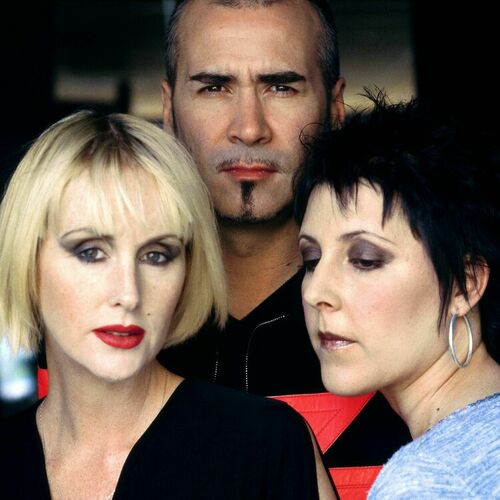
Tap any face to see why they're in the photo

Who shaped them

The Human League

The Human League

Since 1977 · United Kingdom

The Human League formed in Sheffield in 1977 around synthesizer players Martyn Ware and Ian Craig Marsh, whose early records under that name were austere, self-consciously avant-garde electronic music with almost none of the accessible pop the band would later become known for. Their story

See them on the map

Press ▶︎ to play

Loading…

It really plays! Press the middle

Who they shaped

Behind them, left to right: David Bowie, Roxy Music, Brian Eno.

In front, left to right: The Postal Service, Deftones, George Clanton, Liz Phair, Depeche Mode, New Order.

The bigger the face, the stronger the proof: they said it themselvesreporteda critic, or widely accepted

Dare cover

Start here

Dare (1981)

Dare is the record where synth-pop stopped sounding like an experiment and started sounding like the pop mainstream. "Don't You Want Me" carries the album — a call-and-response duet between Philip Oakey and Susan Ann Sulley set against one of the era's most instantly memorable synth hooks, framed as a bitter breakup narrative rather than a straightforward love song. Producer Martin Rushent's arrangements are bright and uncluttered, built to let melody carry weight that guitars usually would. Its combination of accessible songwriting and fully synthetic production gave a generation of British pop acts a template to work from.

Sleeve notes

The Human League

Dare · 1981

The Human League formed in Sheffield in 1977 around synthesizer players Martyn Ware and Ian Craig Marsh, whose early records under that name were austere, self-consciously avant-garde electronic music with almost none of the accessible pop the band would later become known for. When Ware and Marsh left in 1980 to form Heaven 17, singer Philip Oakey was left holding a band name and a management contract with no other members — he responded by recruiting two teenagers, Joanne Catherall and Susan Ann Sulley, off a Sheffield dancefloor, and bringing in musician Jo Callis to help write songs.

That rebuilt lineup, working with producer Martin Rushent, made Dare (1981), the record that turned the Human League from a cult electronic act into a genuine pop phenomenon. Oakey's flat, deadpan baritone and the group's bright, hook-driven synth arrangements became a template other synth-pop acts spent the rest of the decade adapting. The band's commercial fortunes cooled through the later '80s, but Oakey, Catherall, and Sulley have continued performing and recording as the Human League for decades since.

Since 1977 · United Kingdom