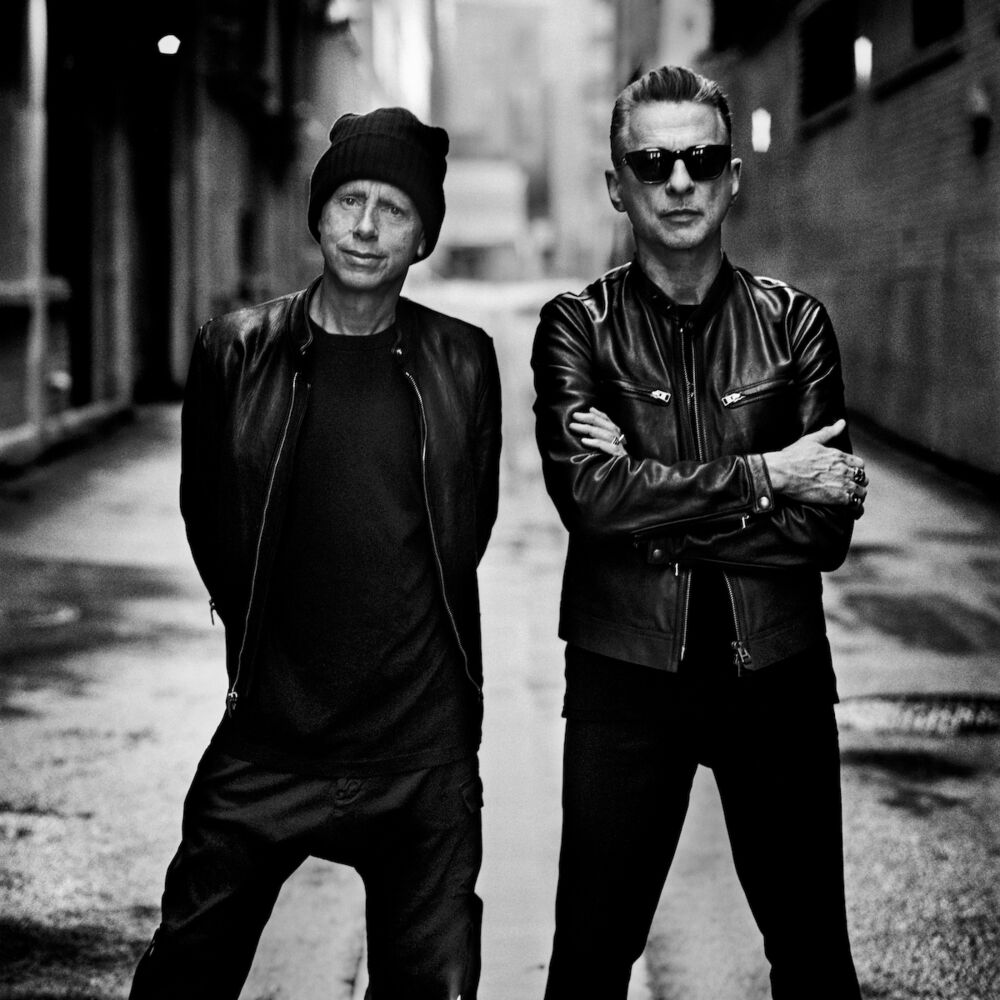
Pictured: Depeche Mode
← Today’s issueThe daily of where sound came fromp. 64
Born 1978 · The Human League and Gary Numan
Synth-pop
Pop songwriting rebuilt entirely from synthesizers and drum machines — melodic, danceable, and deliberately cold-sounding at first, before the coldness itself became a kind of romance. Synth-pop's whole toolkit descends directly from Kraftwerk's own pivot to electronics a few years earlier.
See it on the map →How it started
 Sparks1968
 Gary Numan1977
 The Human League1977
 Orchestral Manoeuvres in the Dark1978
 Depeche Mode1980
 New Order1980
Kraftwerk had already spent most of the 1970s proving a band could be built entirely from synthesizers, but synth-pop as its own genre dates to 1978, when Gary Numan's early singles and The Human League's earliest lineup started writing actual pop songs — verses, choruses, hooks — with that same electronic toolkit rather than treating it as an avant-garde instrument.
For anyone of our generation involved in electronic music, Kraftwerk were the godfathers.
The genre split almost immediately into two audiences: a colder, more art-damaged wing (Numan's own persona, later The Knife and Sparks' theatrical reinvention) and a warmer, chart-facing one (The Human League's Dare, Depeche Mode's eventual stadium-scale run, OMD). Both descend from the same krautrock pivot, and the genre has kept absorbing new tools ever since — its own child, IDM, split off in the 1990s to chase the more experimental end specifically.
Essential records
Start here
Dare
 The Human League1981
Dare is the record where synth-pop stopped sounding like an experiment and started sounding like the pop mainstream. "Don't You Want Me" carries the album — a call-and-response duet between Philip Oakey and Susan Ann Sulley set against one of the era's most instantly memorable synth hooks, framed as a bitter breakup narrative rather than a straightforward love song. Producer Martin Rushent's arrangements are bright and uncluttered, built to let melody carry weight that guitars usually would. Its combination of accessible songwriting and fully synthetic production gave a generation of British pop acts a template to work from.
No. 2
Violator
 Depeche Mode1990
Violator is where Depeche Mode's gothic, industrial-leaning instincts and their pop songwriting finally sat comfortably in the same record. "Enjoy the Silence" builds a colossal hook from almost nothing — a single strummed chord sample, a walking bassline, and Dave Gahan's voice carrying the melody alone — while "Personal Jesus" turns religious longing into a strutting blues-rock riff played entirely on synthesizers. Flood's production gives the whole album a weight and clarity the band's earlier records didn't have, without sanding down Martin Gore's stranger impulses. It's the album most listeners point to when they describe a Depeche Mode record changing how they heard synth-pop.
No. 3
Architecture & Morality
 Orchestral Manoeuvres in the Dark1981
Architecture & Morality is where OMD's early art-school austerity opened out into something warmer and more orchestral, built around choral synth pads, the Mellotron, and melodies indebted as much to church music as to Kraftwerk. "Souvenir" and "Maid of Orleans" carry the record's emotional weight, drifting, hymn-like songs that trade the band's earlier detachment for real tenderness. "Joan of Arc" extends the same instincts into something more explicitly mournful, matching subject and sound with unusual precision for a synth-pop record. It's the album where the band's two songwriting temperaments — McCluskey's directness, Humphreys's atmosphere — fully met in the middle.
No. 4
Power, Corruption & Lies
 New Order1983
Two years after Joy Division's dissolution, New Order arrived at something unprecedented — electronic dance rhythms underneath post-punk guitar textures, polished to a surface that invites the body rather than closing off the world. 'Age of Consent' opens with Peter Hook's melodic bass in counterpoint to the guitars, a technique carried over from Joy Division but deployed here with earned optimism. It taught the entire 1980s underground how synthesisers and guitars could coexist without compromise.
No. 5
The Pleasure Principle
 Gary Numan1979
The Pleasure Principle is the record where Gary Numan committed fully to the synthesizer, building an entire album with no guitars at all — just banks of keyboards, Chris Payne's viola, and a rhythm section drilled into something close to machine precision. "Cars" is the obvious anchor, a paranoid, claustrophobic song about the isolation of driving that became one of the era's most recognizable synth hooks almost by accident. "Metal" pushes the same detachment further, Numan's voice flattened into something between confession and readout. It's a record that treats the synthesizer as a genuinely new instrument rather than a substitute for old ones, and a good deal of synth-pop's early vocabulary comes directly from it.
No. 6
Silent Shout
 The Knife2006
Silent Shout is The Knife at their most austere — minimal techno rhythms, icy synth pads, and Karin Dreijer's voice pitched down into something genderless and unsettling. The title track sets the tone immediately, a queasy, minor-key pulse under vocals that sound like they're being transmitted rather than sung. "Marble House" and "Forest Families" extend the same palette into something closer to horror-film scoring than pop music. It's a deliberately cold, alienating record, and that coldness is the source of its lasting power rather than an obstacle to it.
No. 7
Give Up
Give Up pairs Jimmy Tamborello's glitchy, IDM-derived production — clicking drum programming, warm analog synth pads — with Ben Gibbard's direct, melodically confident indie-pop songwriting, a combination neither had really attempted before. "Such Great Heights" is the clear centerpiece, a bright, yearning love song whose synth melody became as recognizable as the vocal line itself. "Nothing Better," a bickering duet with guest vocalist Jenny Lewis, shows the album's more playful, conversational side. It remains one of the clearest and most listenable bridges between early-2000s indie rock and the electronic music its audience wasn't necessarily already listening to.
No. 8
The Warning
 Hot Chip2006
The Warning is where Hot Chip's early bedroom-pop melodicism met a much more confident, clubby production sensibility. "Over and Over" rides a simple, insistent cowbell pattern and a chanted vocal hook that turns repetition itself into the song's main event, a deadpan nod to Kraftwerk's own motorik pulse. "Boy from School" slows things down into something more melancholic, proving the band could sustain a mood as well as a groove. The album's blend of wit, warmth, and genuinely danceable production made it one of the more purely enjoyable records to come out of mid-2000s British electronic-pop.

Who plays it
The founding wave, 1978–1983
The genre's first chart-facing generation — some (Numan, The Human League's early records) colder and more art-damaged, others (OMD, Depeche Mode, New Order arriving from post-punk) building toward something warmer and more danceable.
Art-damaged synth-pop
A theatrical, deliberately strange strand — Sparks predates synth-pop by years but found a second life within it; The Knife pushed the genre's coldness toward outright menace.

The 2000s–2010s revival
A generation of indietronica and internet-native artists rediscovered the genre's warmth, often filtered through nostalgia for its own earliest records.


Where synth-pop blurs
Artists for whom synth-pop is one ingredient rather than a home genre — EDM, art-pop, and folk-turned-electronic all get fuller tellings elsewhere on this site.


Where it came from, where it went
- Art rock1967
- Krautrock1968
- Synth-pop1978
- Where it went