
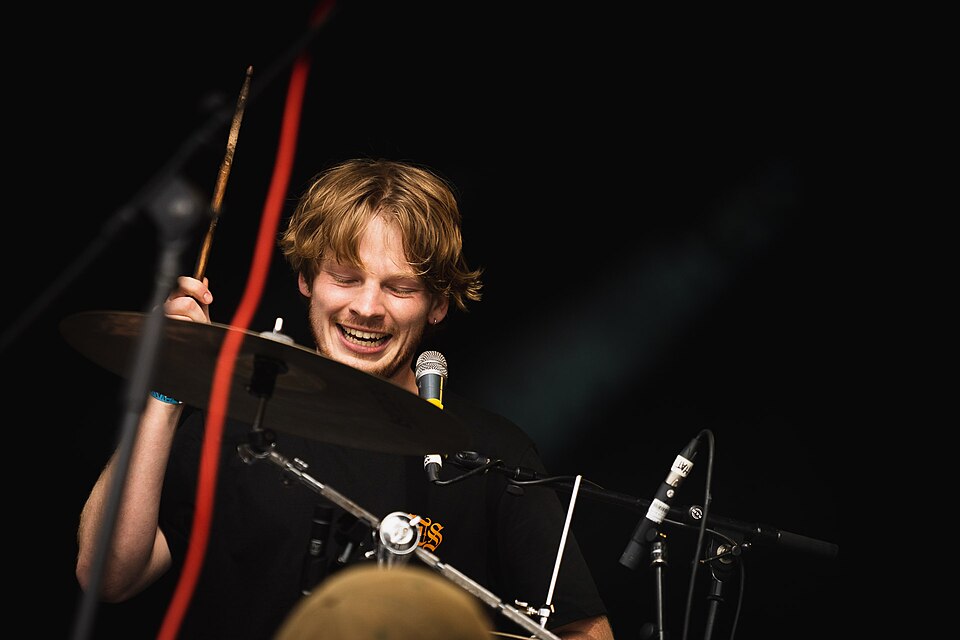
Pictured: Kraftwerk
← Today’s issueThe daily of where sound came fromp. 60
Born 1968 · Can and Amon Duul form in West Germany
Krautrock
West Germany's postwar generation refusing to inherit Anglo-American blues-rock — hypnotic, motorik rhythm and studio experimentation in its place. Krautrock is a single, compact scene, but its downstream runs through nearly every electronic genre in this map.
See it on the map →How it started


Can and Amon Düül both formed in 1968, assembled out of a generation with one foot in experimental composition — Can's Irmin Schmidt and Holger Czukay had studied under Karlheinz Stockhausen — and no interest in reproducing American or British rock's blues scales and song forms. Neu! (1971) and Faust (also 1971) pushed the same instinct toward starker extremes: Neu! down to a single relentless drumbeat, Faust into tape collage and studio demolition.
The influence, for me, of Beatles and Velvet Underground was most important. The Velvet Underground especially. They had something achieved which others didn't achieve.
Kraftwerk started in this same scene before moving fully electronic, and that pivot is the real hinge of krautrock's legacy — synth-pop, ambient, and industrial all descend from it directly, with IDM, hyperpop, and post-rock several steps further down the same tree. The scene itself was brief and German, but its motorik pulse resurfaced decades later in artists like Stereolab, Tortoise, and Squid, none of whom were within a generation of the original bands.
Essential records
Start here
Future Days
 Can1973
Can's third album with singer Damo Suzuki traded the sprawling improvisation of Tago Mago for something more atmospheric and dissolved — long, floating pieces built from Jaki Liebezeit's impossibly steady motorik pulse and Holger Czukay's tape-collage production. The title track drifts on shimmering guitar and synthesizer textures until it barely resembles a rock song at all; 'Moonshake' compresses the same instincts into something closer to a pop single. It was Suzuki's final record with the band before he left to become a Jehovah's Witness, and it stands as the most serene and most influential entry in a catalog that shaped ambient, post-rock, and electronic music for decades after.
No. 2
Neu!
 Neu!1972
Klaus Dinger and Michael Rother distilled krautrock to its rhythmic essence on this debut — the steady, forward-driving 'motorik' beat Dinger devised on a cheap drum kit became one of the most influential patterns in rock history. 'Hallogallo' rides that beat for ten minutes of pure forward motion, guitars and effects drifting over it like landscape passing a train window. 'Negativland' shows the album's more abrasive, proto-punk side. Made on a shoestring budget and barely noticed on release, it became a foundational reference point for Bowie, Eno, and two generations of motorik-obsessed bands after.
No. 3
Faust IV
 Faust1973
Faust IV opens with "Krautrock," a nearly twelve-minute wall of drone and motorik rhythm that turns a term critics used dismissively into a statement of purpose. The record moves between that kind of extended abstraction and surprisingly direct songwriting — "Jennifer" and "Just a Second (Starts Like That!)" are almost pop songs, played by a band that clearly didn't trust pop songs to stay simple for long. Recorded in England for Virgin at the tail end of the band's most productive run, it's the most accessible entry point into a catalog otherwise defined by its refusal of accessibility. Decades on, it still reads as an argument about what a rock record is allowed to be.
No. 4
Trans-Europe Express
 Kraftwerk1977
Kraftwerk built an entire electronic vocabulary from synthesizers, vocoders, and drum machines alone, imagining a gleaming, mechanized Europe as the album's organizing metaphor. The title track's motorik pulse and deadpan vocal delivery became a foundational reference point for synth-pop, techno, and hip-hop alike — Afrika Bambaataa lifted its melody wholesale for 'Planet Rock.' 'Showroom Dummies' extends the band's man-machine conceit into something genuinely funny and genuinely eerie at once. Few albums have shaped as many unrelated genres as thoroughly as this one.
Who plays it
The scene and its heirs
Can, Neu!, and Faust are the actual 1968–73 originators, all German and all working within a few years of each other; Kraftwerk started alongside them before turning fully electronic. Stereolab, Tortoise, and Squid arrived decades later and from entirely different countries, absorbing the motorik pulse as an influence rather than living inside the original scene — heirs, not participants.
Where it came from, where it went
- Art rock1967
- Krautrock1968
- Where it went