
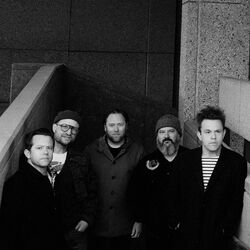
Pictured: American Football
← Today’s issueThe daily of where sound came fromp. 54
Born 1997 · Cap'n Jazz and American Football
Midwest emo
Emo's twinkly, technically intricate Midwestern branch — clean, interlocking guitar lines closer to math-rock than to hardcore's shout, paired with the same diaristic, heart-on-sleeve lyrics. The name is more sonic lineage than literal map: some of its most important records were made outside the actual Midwest.
See it on the map →How it started




Cap'n Jazz, formed by teenage members of Chicago's Kinsella family in the northern suburbs, spent the mid-1990s writing hardcore-fast songs already threaded through with clean, chiming guitar interplay closer to a conversation than a riff. When the band dissolved in 1995, its members scattered into a small constellation of related projects — the most important of them American Football, formed in Urbana in 1997 around Mike Kinsella, who made exactly one album before splitting: a quiet, jazz-chorded, trumpet-inflected record that went on to define the entire genre's sound for a generation of bands who came after it.
We never saw Rites of Spring, but their record mattered to us,
The genre owes an equally real debt to a band that never set foot in the Midwest: Sunny Day Real Estate's Diary, recorded in Seattle in 1994, established the melodic, unguarded vocal approach and the clean-to-distorted dynamic swing that Cap'n Jazz and American Football would apply their own intricate guitar vocabulary to — the fuller story of Diary's place in emo more broadly is told on emo's own page. What Champaign-Urbana added was the guitar interplay itself, interlocking and contrapuntal enough that it eventually needed a name separate from emo's wider story.
Essential records
Start here
American Football
American Football trades the hardcore urgency of the band members' earlier projects for something quieter and more intricate: twinkling, interlocking guitar lines, jazz-inflected chords, and trumpet drifting through the mix. "Never Meant" builds a whole song out of a single conversational guitar figure, Mike Kinsella's plainspoken vocal sitting almost shyly in the mix rather than out front. The band broke up shortly after its release, with little sense the record would be remembered. Rediscovered over the following decade, it became one of the most quietly influential albums in the midwest-emo and "twinkly" post-rock scenes that followed.
No. 2
Analphabetapolothology
 Cap'n Jazz1998
Analphabetapolothology gathers Cap'n Jazz's scattered, hard-to-find singles and unreleased material into the record most people actually know the band by, years after the band itself had broken up. "Little League" captures the band at its most manic and most melodic simultaneously, Tim Kinsella's yelped vocals riding over guitar lines from Victor Villarreal and Sam Zurick that veer between chaos and genuine hook. The compilation format means the whole thing feels less like a planned statement than a document of a band that could barely contain itself. It's since become recognized as one of the direct sources of the midwest-emo sound its own alumni went on to refine.
No. 3
Something to Write Home About
 The Get Up Kids1999
Something to Write Home About takes emo's emotional directness and pairs it with hooks big enough to work on rock radio without losing any of the genre's urgency. "Action & Action" rides a driving, straightforward riff into a chorus built for a room singing along, Matt Pryor and Jim Suptic's dual vocals trading the emotional weight back and forth. The record's polish never comes at the expense of its intensity. It became one of the defining albums of emo's more melodic, pop-facing second wave, and one of the releases that helped define Vagrant Records' identity.
No. 4
Diary
Diary takes post-hardcore's structural tension and points it toward open catharsis instead of controlled restraint. "Seven" builds from a hushed, searching verse into a chorus where Jeremy Enigk's voice cracks open completely, the interlocking guitars of Enigk and Dan Hoerner swelling to match. Nate Mendel and William Goldsmith's rhythm section gives the songs a physical weight that keeps the emotional intensity from ever feeling indulgent. It's now regarded as one of the founding records of what would come to be called emo's second wave.


Who plays it
The Champaign-Urbana axis
The genre's actual founding sound — Cap'n Jazz's manic twinkle, American Football's quiet jazz-chord version of the same idea, and Sunny Day Real Estate's Seattle-made template for the vocal and dynamic side of it, which gets its own fuller telling on emo's page.
The wider circle
Contemporaries who carried the same twinkling-guitar, confessional sound in different directions and different cities — Get Up Kids toward pop hooks and a major-label audience, Christie Front Drive toward Denver's own version of the Midwest sound, Duster toward something hazier and closer to slowcore.
Where it came from, where it went
Nothing on the map has grown out of it yet.