
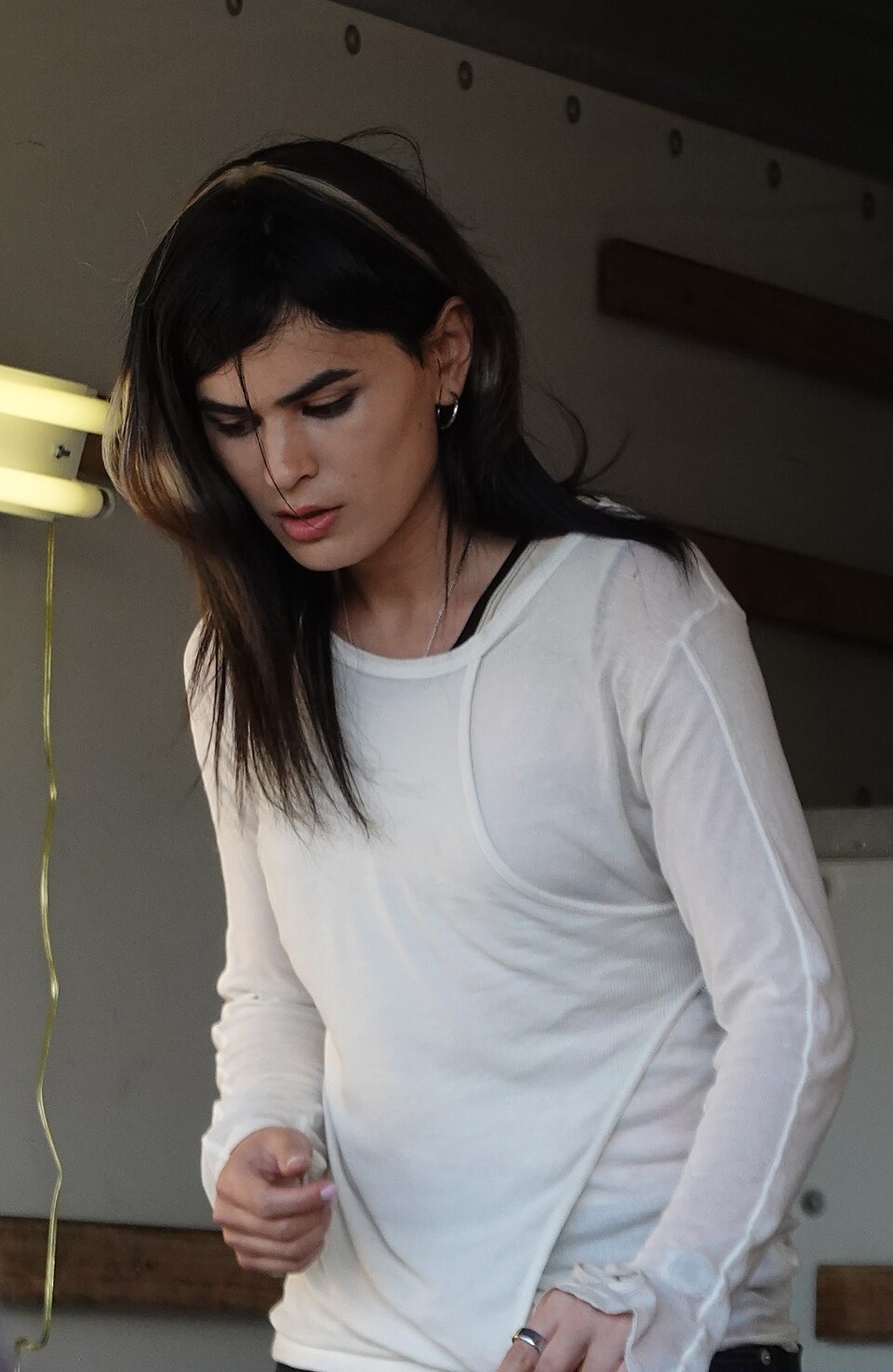
Pictured: SOPHIE
← Today’s issueThe daily of where sound came fromp. 72
Born 2013 · PC Music founded
Hyperpop
Pop pushed past the point of good taste on purpose — pitched-up vocals, deliberately abrasive compression, and a maximalist, internet-native production style that treats genre boundaries as something to splice through mid-song rather than respect.
See it on the map →How it started


The term traces to PC Music, the London collective A.G. Cook founded in 2013 to make pop music that was sincere and satirical at the same time — bubblegum melodies run through aggressively synthetic, almost painful production. SOPHIE was there from nearly the start, and her solo work pushed the label's ideas into something stranger and more physical, closer to body horror than pop parody.
And of course, someone who none of us would be up here without, SOPHIE.
A second wave arrived once Spotify's own "hyperpop" playlist gave the loose, internet-native scene around Discord and SoundCloud a name and an audience it hadn't asked for — artists who'd been making what they called digicore or just their own thing found themselves filed under the same label as PC Music's much more deliberate art project.
Essential records
Start here
Oil of Every Pearl's Un-Insides
 SOPHIE2018
Oil of Every Pearl's Un-Insides pushes SOPHIE's exaggerated, synthetic textures — pitched vocals, rubbery basslines, sounds that seem to melt and reform mid-song — into service of genuinely personal songwriting rather than pure sonic provocation. "Immaterial" is the clearest distillation, a giddy, maximalist pop song about identity as something chosen and rebuilt rather than fixed. "It's Okay to Cry," the album's lead single, paired an unusually tender vocal performance with SOPHIE's first public appearance as herself. The record argues that hyperpop's most artificial-sounding textures could carry as much genuine feeling as any conventional pop production, and much of the genre's subsequent decade took that argument as a starting point.
No. 2
1000 gecs
 100 gecs2019
1000 gecs crams half a dozen genres into songs that rarely last past the two-minute mark, distortion pushed so far past comfortable levels that it becomes the point rather than a flaw. "money machine" is the clearest entry point, Laura Les's pitch-shifted vocal riding a beat that swings between ska guitar, dubstep bass drops, and pop-punk shout-along energy without any of it feeling like a transition. "stupid horse" and "745 sticky" show the same instinct for genre collision applied even more aggressively. The album's sheer density and refusal to resolve into one sound became a genuine reference point for hyperpop as it moved from internet niche to a term major labels started using.
No. 3
7G
 A.G. Cook2020
7G is less a conventional album than a demonstration of range, a sprawling, multi-disc release moving between glitchy pop, ambient interludes, and straightforwardly pretty songwriting without settling into any single mode for long. "Oh Yeah" is one of the record's more accessible moments, a bright, hooky pop song that still carries the slightly uncanny, over-processed quality running through Cook's production generally. Elsewhere the record swings into much stranger territory, treating its own scale as license to try nearly everything at once. It's a useful map of A.G. Cook's actual range, released at a moment when most listeners only knew him through his work for other artists.
No. 4
Wallsocket
 underscores2023
Wallsocket sets its songs in a half-real, half-invented version of a small Michigan town, using that fictional geography to hold together a record that otherwise jumps between hyperpop distortion, pop-punk energy, and country-inflected melody. "Locals (Girls like us)" is one of the clearest distillations, blending a twangy melodic hook with glitchy, maximalist production in a way that shouldn't cohere as well as it does. "Johnny Johnny" and "Uncanny Long Arms" show the record's range, one more anthemic, the other stranger and more fragmented. It's an unusually cohesive record for a genre often defined by its restlessness, held together by a concept as much as by any single sonic signature.
Who plays it
PC Music and its circle
The genre's original, more deliberate art-project wing, centered on A.G. Cook's label and the artists closest to it.
The digicore generation
A looser, younger, internet-native second wave — Discord and SoundCloud rather than a London studio — that absorbed the hyperpop label after the fact.

Where it came from, where it went
- Art rock1967
- Krautrock1968
- Synth-pop1978
- IDM1992
- Hyperpop2013
Nothing on the map has grown out of it yet.