
Pictured: Mazzy Star
← Today’s issueThe daily of where sound came fromp. 80
Born 1990 · The Flaming Lips and Mercury Rev
Neo-psychedelia
60s psychedelia's studio experimentation and cosmic ambition, revived by artists with no direct link to the original scene beyond a shared record collection. Neo-psychedelia treats the 1960s not as a place to return to but as a toolkit — vintage synths, backwards tape, maximalist arrangement — for building something new.
See it on the map →How it started
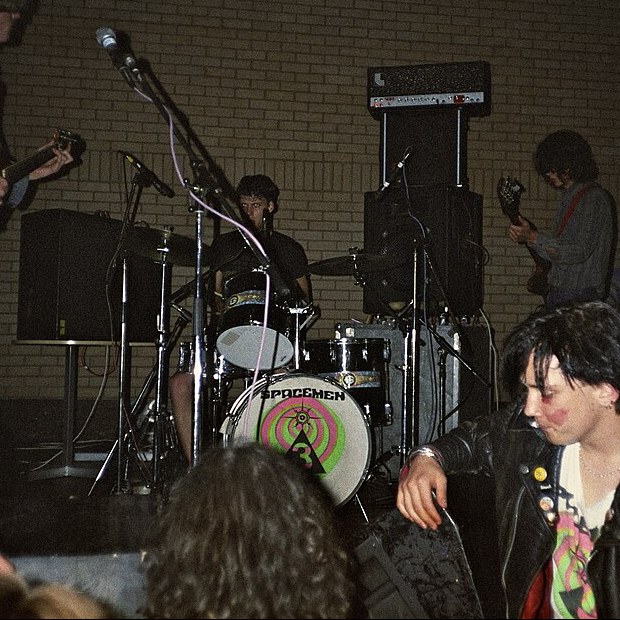 Spacemen 31982
 The Flaming Lips1983
 Mazzy Star1988
 Candy Claws2007
 Tame Impala2007
 King Gizzard and the Lizard Wizard2010
The Flaming Lips and Mercury Rev both emerged around 1990 pushing American indie rock toward the 1960s' most extravagant studio techniques — layered tape effects, orchestral arrangement, songs that swelled rather than just played — at a moment when the wider indie underground was mostly moving the opposite direction, toward lo-fi minimalism. Mercury Rev isn't on this map, but the Flaming Lips' own arc from noisy guitar band toward The Soft Bulletin's symphonic maximalism follows exactly that same instinct.
I think that's something we got from the Stooges, 'O.D. Catastrophe'.
Mazzy Star, working slightly earlier out of Los Angeles's Paisley Underground scene, carried a quieter, more Southern-gothic version of the same 60s inheritance. A much larger second wave arrived in the 2010s, once Tame Impala's bedroom-studio take on the sound proved a single producer with vintage gear and a laptop could chase the same cosmic scale the Flaming Lips had needed a full band and a real budget for.
Essential records
Start here
The Soft Bulletin
 The Flaming Lips1999
The Soft Bulletin builds lush, orchestral arrangements out of layered strings, synthesizers, and processed drums, a dramatic departure from the noisier, more guitar-driven records that came before it. "Race for the Prize" opens the album on a swelling, almost symphonic note, Wayne Coyne's plainspoken meditations on mortality and heroism riding a melody big enough to match the ambition of the production. The record's maximalist studio approach never buries the emotional directness underneath it. It stands as the moment the Flaming Lips became one of the most critically significant bands of their generation, decades removed from the hardcore scene that first shaped them.
No. 2
Currents
 Tame Impala2015
Currents trades Tame Impala's earlier guitar-driven psychedelia for synthesizer-heavy, groove-forward production closer to disco than to rock. "The Less I Know the Better" rides a slinky, funk-inflected bassline into a chorus about jealousy and self-doubt delivered with a warmth that undercuts the lyric's discomfort. Kevin Parker's total control over every element of the production gives the record a singular, cohesive feel despite its stylistic distance from his earlier work. It remains the album most responsible for bringing Tame Impala's psychedelic sensibility to an audience far outside rock's usual boundaries.
No. 3
Nonagon Infinity
 King Gizzard and the Lizard Wizard2016
Nonagon Infinity runs as a single unbroken loop, each of its nine songs crashing directly into the next with no gap, until the album's final track feeds seamlessly back into its opening. "Robot Stop" kicks the cycle off at full speed, a driving garage-rock riff and Stu Mackenzie's urgent vocal setting a pace the rest of the record never lets up. The structural conceit could easily have been a gimmick, but the songwriting underneath is tight enough to sustain it. It stands as one of the purest distillations of King Gizzard's restless, high-concept energy in a discography defined by restlessness.
No. 4
Crumbling
 Mid-Air Thief2018
Crumbling layers acoustic guitar, field recordings and warped electronic production into a dense, headphone-rewarding collage that rewards repeated listening more than any single pass. "These Chains" folds a genuinely pretty vocal melody into a constantly shifting bed of samples and texture, never settling long enough to feel predictable. The whole album favors accumulation over hooks, treating each song as a small, detailed world rather than a single statement. It remains the release most responsible for building Mid-Air Thief's reputation as one of psychedelic pop's most quietly ambitious voices.
Who plays it
The first wave, 1988–1990
Mazzy Star's Paisley Underground haze and the Flaming Lips' early art-damaged noise-pop both revived the 1960s' studio ambition before the term "neo-psychedelia" had really caught on.
The 2010s revival
A much larger second wave, built mostly out of bedroom studios rather than full bands — Tame Impala's solo-recorded cosmic pop, King Gizzard's relentless genre-hopping prolificacy, and a quieter, more internet-native strand in Mid-Air Thief and Candy Claws.

Where it came from, where it went
- Psychedelic pop1966
- Neo-psychedelia1990
Nothing on the map has grown out of it yet.