
Pictured: Low
← Today’s issueThe daily of where sound came fromp. 104
Born 1990 · The Stars of the Lid generation of long-form drone
Drone
Music reduced to sustained tone and almost nothing else — a single chord, or even a single note, allowed to hang and slowly mutate for the length of an entire piece. Drone takes ambient's patience and removes the last of its melodic incident, asking a listener to sit inside one sound rather than follow it anywhere.
See it on the map →How it started

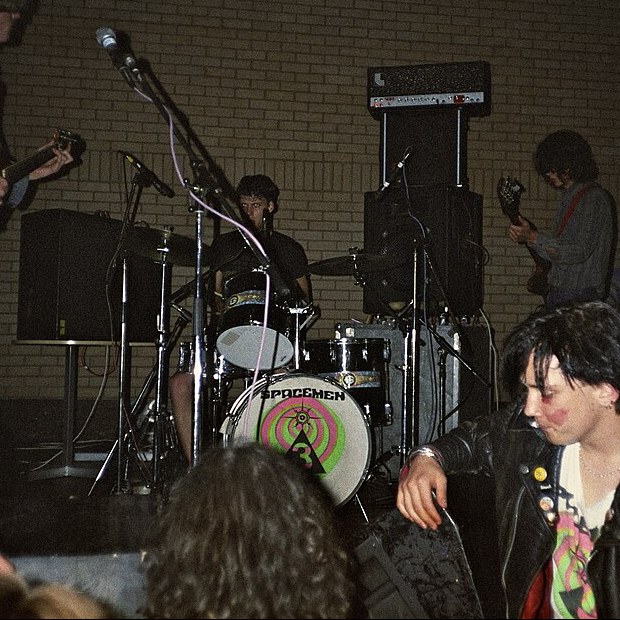


Drone as a technique predates any genre built around it by decades — La Monte Young's minimalist sustained-tone experiments in the early 1960s and centuries of raga and Indian classical practice did the same thing long before rock or electronic music picked it up. As its own recognizable current within this map's world, though, drone dates to around 1990, when Stars of the Lid began stretching guitar and tape loops into pieces that could run twenty minutes on a single, barely-moving chord.
It was definitely an early subconscious template for whatever Low was when we started.
The style spread in two directions from there: an electronic wing (Tim Hecker's processed, physically overwhelming tone clouds) and a rock-adjacent one, where slowcore's already glacial tempos (Low, Mount Eerie) and post-rock's quietest passages (Mono, Dirty Three, Spiritualized) simply kept slowing down until incident disappeared almost entirely.
Essential records
Start here
And Their Refinement of the Decline
 Stars of the Lid2007
And Their Refinement of the Decline is Stars of the Lid at their most orchestral, layering strings, brass, and processed guitar into long, slow-moving pieces with almost no percussive element to mark time. "Even If You're Never Awake" unfolds over several minutes without a clear beginning or end, individual instruments impossible to isolate inside the overall haze. "Dungtitled (In A Major)" pushes the same approach across an even longer arc, patience functioning as the record's central technique rather than an incidental quality. It remains one of the more fully realized documents of drone as a genuinely orchestral, rather than purely electronic, practice.
No. 2
Flood
 Boris2000
Flood is one seventy-minute piece in four parts that rises out of near-silence and takes its time getting anywhere. "Flood I" opens on a single clean guitar figure repeated almost to stillness, and only much later does the band let it swell into a long, crushing roar before it ebbs away again. Nothing is hurried; the patience is the point, and it lets a heavy band sound close to ambient music. It's the record that shows drone can be beautiful, not just loud.
No. 3
Ravedeath, 1972
 Tim Hecker2011
Ravedeath, 1972 was built from recordings made on the pipe organ of a church in Reykjavik, later layered, pitch-shifted, and buried under distortion until the source instrument becomes almost unrecognizable. "The Piano Drop" — its title referencing the album's cover photo of an MIT prank gone slightly wrong — rides a queasy, detuned melodic figure through waves of saturation that keep threatening to swallow it entirely. "In the Fog" extends the same idea across a longer, more patient arc. It's a record about beauty surviving heavy damage, and its scale and physical intensity set a high bar for the ambient and drone records that followed it.
No. 4
A I A: Alien Observer
 Grouper2011
A I A: Alien Observer buries Liz Harris's voice and guitar so deep in reverb and tape hiss that the songs function more as weather than as narrative — melody is present throughout, but it arrives filtered through so much haze that it registers as mood before it registers as tune. The title track sets the pattern immediately, a slow, layered wash where individual chords blur into each other rather than resolving cleanly. The tracks around it favor repetition and duration over conventional song structure, asking the listener to sit inside the sound rather than follow it. It's one of the more fully immersive records in the drone-adjacent end of the dream-pop and ambient continuum Grouper works between.
No. 5
The Winter Ray
The Winter Ray is the duo's first sprawl on the scale they would become known for -- a self-released double album of twenty-five pieces that moves between two-minute fragments and seventeen-minute drones without ever changing its weather. Mehdi Ameziane and Solange Gularte record everything at home, and the tape hiss and room noise are part of the composition rather than a limitation of it. "Dead Horses" and "I Was Always Cold" are the long pieces the record is built around, while "Overture" and the title track work as the brief clearings between them. Issued in a tiny hand-assembled edition, it established the method every later Natural Snow Buildings record refines.
No. 6
Dead Magic
Dead Magic lets the pipe organ's full, room-filling weight dominate the record, Anna von Hausswolff playing the instrument with a volume and physicality closer to a rock musician than a church organist. "The Mysterious Vanishing of Electra" builds its dread slowly, organ drones swelling under her wordless, operatic vocal until the track's scale feels closer to a cathedral than a studio recording. Recorded in an actual Copenhagen church, the album uses the room's natural reverb as an instrument in its own right. It stands as one of the most physically overwhelming drone records made with a fundamentally classical instrument.
No. 7
Deathconsciousness
 Have A Nice Life2008
Deathconsciousness buries pop melodies under thick, distorted layers of guitar and drum machine, the production so dense and murky that entire songs sound like they're being heard through a wall. "Bloodhail" pairs a genuinely catchy vocal melody with a wall of scraping noise and a martial drum pattern, the mix refusing to let any single element sit comfortably on top. Elsewhere the record slows into doom-laden dirges that barely qualify as songs in a conventional sense. Self-released with almost no attention, it has since become one of the most quietly influential cult records in underground guitar music.



Who plays it
Ambient's outer edge
Drone's most directly ambient-descended wing — tone and texture stretched past the point where "song" is even the right word.


Slowcore's drone wing
Slowcore's already glacial tempos, taken all the way to a full stop — these three carry both tags, and the slower of the two eventually wins out entirely.


Post-rock's droniest edge
Artists whose post-rock leans on sustained tone and volume rather than crescendo and release — the quietest, least song-shaped corner of that genre.

Gothic and orchestral drone
Anna von Hausswolff builds drone out of pipe organ and gothic scale rather than guitar or synthesizer — a stranger, more liturgical register than anywhere else on this page.

Heavy drone
Drone played at crushing volume by a rock band: Boris stretch a single riff or guitar figure until it becomes a place to stand in, then let it swell into a roar.