
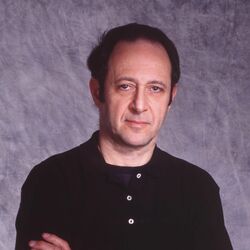
Pictured: Steve Reich
← Today’s issueThe daily of where sound came fromp. 100
Born 1964 · Terry Riley, In C
Minimalism
Music built from repetition: short patterns played over and over, drifting slowly out of step with each other until the shifting itself becomes the music. It began with composers in 1960s New York, and a generation later it was being played on massed electric guitars in the same city's rock clubs.
See it on the map →How it started


Terry Riley's In C (1964) gives minimalism its starting date: short melodic cells, repeated and layered by an ensemble until the overlapping patterns become the whole piece. Steve Reich took the idea somewhere new the next year, letting two tape loops of the same voice drift out of sync in It's Gonna Rain, then asking two pianists to do it live in Piano Phase. His ensemble works of the 1970s, Drumming and Music for 18 Musicians, are the records that carried it out of the concert hall: Brian Eno built his studio method on Reich's out-of-sync loops, and Slint, Squid and American Football all say he shaped their music.
became my go-to technique for making something interesting straight away.
New York's no-wave scene pointed the same logic at the electric guitar. Glenn Branca and Rhys Chatham, who says his own phasing riffs were directly inspired by Piano Phase, built pieces for a dozen or more detuned, overdriven guitars, minimalism's repetition and drift turned into a wall of harmonic overtones: Branca's The Ascension (1981) and Chatham's Die Donnergötter (1985) define that branch.
Essential records
Start here
Music for 18 Musicians
 Steve Reich1978
Music for 18 Musicians is an hour of pulsing that never stands still: a cycle of eleven chords, each stretched into a section of its own, played by pianos, marimbas, clarinets and wordless voices breathing in long phrases. "Music for 18 Musicians" opens on that cycle, the whole ensemble pulsing together before the patterns begin to shift. Nothing is sudden, yet everything is always changing, which is what makes it so hypnotic. It's the record that carried minimalism out of the concert hall and into the ears of rock and electronic musicians.
No. 2
The Ascension
 Glenn Branca1981
The Ascension treats a wall of electric guitars as raw material for something closer to minimalist orchestral composition than to rock as usually understood. "The Spectacular Commodity" builds from droning, overtone-rich guitar textures into a dense, ringing mass of sound, the massed instruments generating overtones no single guitar could produce alone. The record trades riffs and solos for pure sonic architecture, treating volume and sustain as compositional tools in their own right. It remains a foundational document for how far rock instrumentation could be pushed toward the classical avant-garde.
No. 3
Die Donnergötter
 Rhys Chatham1985
Die Donnergötter extends Rhys Chatham's massed-guitar approach into a larger, more symphonic arrangement, treating a stage full of electric guitars as a single instrument capable of generating overtones no individual player could produce alone. "Guitar Trio," the piece that established Chatham's whole method years earlier, rides a driving, motorik rhythm while the massed guitars build a dense, ringing wash of harmonic overtones above it. The effect is somewhere between rock propulsion and minimalist classical composition, neither quite describing it fully. It remains one of the clearest demonstrations of how radically the electric guitar could be reconceived outside of riffs and solos.
Who plays it
The composers
Steve Reich's phasing, tape loops and pulsing ensembles: the root that Brian Eno, Slint, Squid and American Football all name.
Massed-guitar minimalism
Two composers, both working out of New York's no-wave scene circa 1979–81, who took minimalism's repetition-and-drone logic and rebuilt it out of overdriven electric guitars rather than an ensemble of conventional instruments.
Where it came from, where it went
- Minimalism1964
- Where it went
Nothing on the map came before it: this is where its road starts.