Tap any face to see why they're in the photo

Who shaped them

Vashti Bunyan

Vashti Bunyan

Since 1965 · United Kingdom

Vashti Bunyan recorded a handful of singles in London's mid-1960s pop scene, produced by figures like Andrew Loog Oldham, before abandoning that path entirely… Their story

See them on the map

Press ▶︎ to play

Loading…

It really plays! Press the middle

Who they shaped

Behind them, left to right: Bob Dylan.

In front, left to right: Oklou, Joanna Newsom.

The bigger the face, the stronger the proof: they said it themselvesreporteda critic, or widely accepted

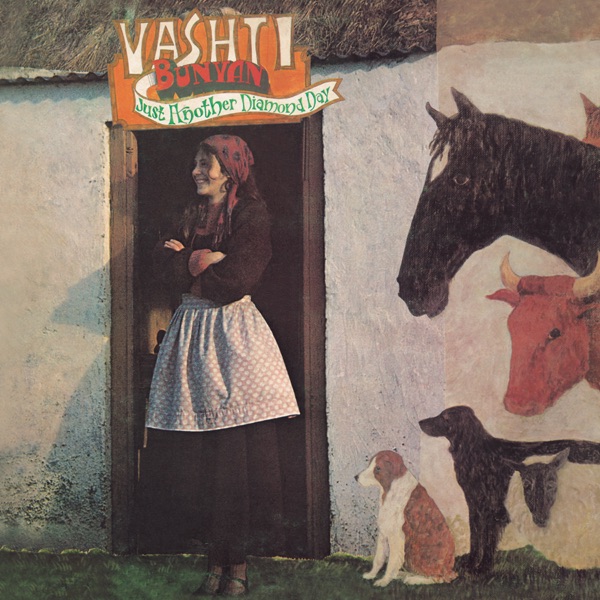
Just Another Diamond Day cover

Start here

Just Another Diamond Day (1970)

Recorded with musicians from the Incredible String Band's circle, Just Another Diamond Day sounds exactly like what it was: songs written on a slow journey by horse and cart, arranged with recorder, fiddle, and the barest possible touch. The title track's melody is almost a lullaby, Bunyan's voice pitched so quietly it asks the listener to lean in rather than the record reaching out. Nothing on it aims for a hook in any conventional sense, and that refusal is exactly what later musicians responded to decades after its release. It remains one of the gentlest records in the British folk revival's catalog.

Sleeve notes

Vashti Bunyan

Just Another Diamond Day · 1970

Vashti Bunyan recorded a handful of singles in London's mid-1960s pop scene, produced by figures like Andrew Loog Oldham, before abandoning that path entirely: in 1968 she and her partner set off by horse-drawn cart for a commune on the Scottish island of Skye, writing songs along the way that would become her debut album. Just Another Diamond Day (1970) sold almost nothing on release and Bunyan stopped making music for over three decades, convinced the record had been a failure.

Its rediscovery by collectors and a new generation of folk-influenced musicians in the early 2000s reversed that verdict completely, and Bunyan returned to recording with Lookaftering (2005) and later albums. Her whispery, unadorned voice and pastoral, English-folk arrangements became a direct touchstone for the "freak folk" scene that emerged around the same time, several of whose key figures have cited her as a formative discovery.

Since 1965 · United Kingdom